

Cookery Classes

I teach Turkish cooking classes in England,Turkey & USA, hope you can join us!,
Find Out More

Recipes    

Turkish cuisine provides healthy, hearty, delicious food for family and friends.
Find out more

Tag Archives | vegan recipes

Candied Pumpkin Dessert with Walnuts, Turkish Style; Kabak Tatlisi

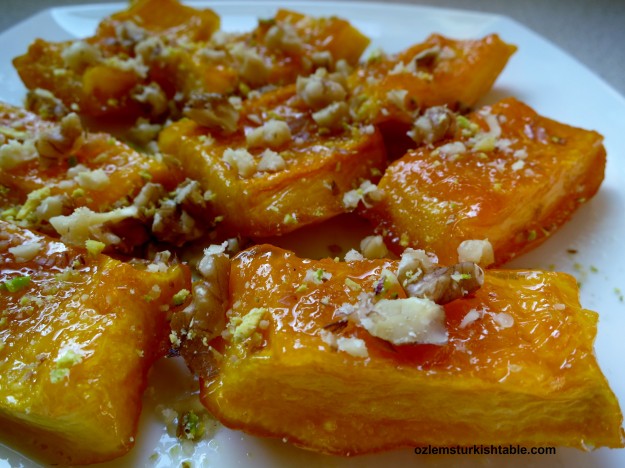
Turkish candied pumpkin dessert, Kabak Tatlisi; so easy and scrumptious

Turkish candied pumpkin dessert, Kabak Tatlisi; so easy and scrumptious

We all have pumpkins in our minds at this time of the year; I love its natural sweetness and comforting, luscious flavor. This scrumptious candied pumpkin dessert is popular in Türkiye and it is so very easy to make. Pumpkin is baked here in its very own juice with sugar and the result is an exquisite dessert with the full flavor of pumpkin, also fancy enough to share with family and friends.

This lovely light dessert, Kabak Tatlısı, is wonderful served with crushed walnuts. In Türkiye , it is also served with our thick clotted cream, kaymak. If you can’t get kaymak, clotted cream also complements this dessert well. You can also add a few cloves or cinnamon sticks to its juice before baking, if you’d like to spice up this dessert. Butternut squash also works well in this recipe.
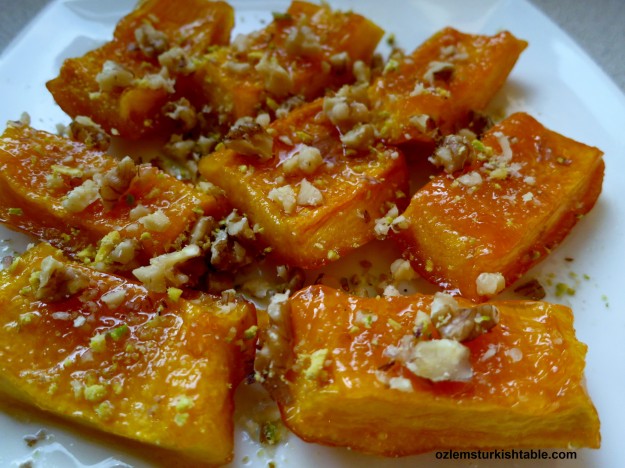
Luscious candied pumpkin dessert, Kabak Tatlisi; great for entertaining

Luscious candied pumpkin dessert, Kabak Tatlisi; great for entertaining

I hope you can give this delicious, glistening pumpkin dessert a try; it may also be a lovely addition for your holiday entertaining and a  great way to use up pumpkin leftover from Halloween, too. I like the Crown Prince variety, though I made this dessert successfully with regular pumpkin, as well as butternut squash too. For a delicious variation, drizzle a little tahini over the baked pumpkin when serving.

Why not also, have a go at my Pumpkin and Walnut Baklava, from my new book SEBZE? Inspired by our pumpkin dessert, I used luscious baked pumpkin pieces, combined with walnuts and cinnamon, in my festive version of baklava, so delicious, easy and lighter. You can get your copy of SEBZE here.

Serves 6 – 8

1kg/2 ¼ lb. pumpkin flesh, peeled, deseeded and cut into chunky cubes or rectangular blocks (about 3” long)

250gr/9 oz. / 1 ½ cup sugar

225gr/1 cup crushed walnuts to serve

Turkish clotted cream, Kaymak or clotted cream to serve (optional)

Preheat the oven to 180C/350F
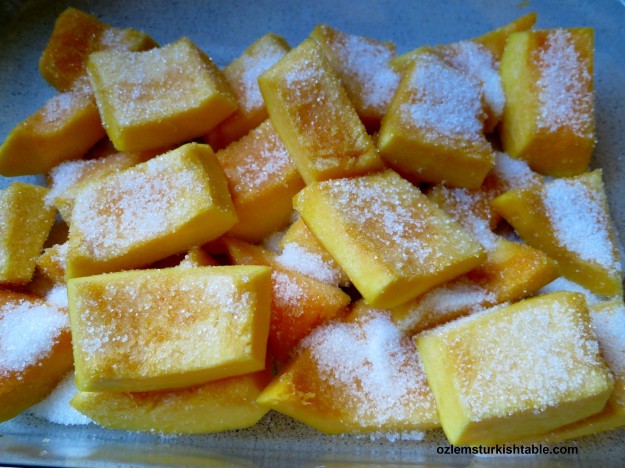
Sprinkle sugar over the pumpkin pieces evenly.

Sprinkle sugar over the pumpkin pieces evenly.

Line the bottom of a large baking dish with the prepared pumpkin pieces and sprinkle sugar over them evenly. Then layer the rest of the pumpkin chunks and pour the remaining sugar evenly over them. Cover the dish and let it rest overnight.
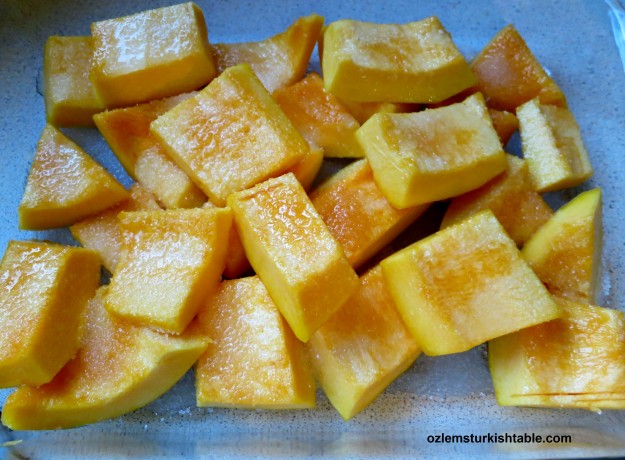
Let the sugar coated pupmkin pieces rest overnight; even after 30 minutes, you notice the juices coming up.

Let the sugar coated pumpkin pieces rest overnight; even after 30 minutes, you notice the juices coming up.

The next day, you will notice that the pumpkin has released all its juices and that the pieces are nearly covered with all that wonderful juice. This liquid is all you need to bake the pumpkin, no need to add any extra water.
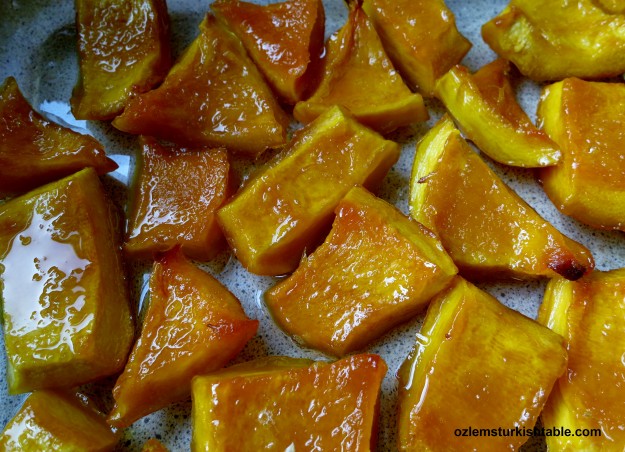
Baked, candied pumpkin, utterly delicious.

Baked, candied pumpkin, utterly delicious.

Bake the pumpkin in the preheated oven, uncovered. Every 20 minutes, spoon the syrup in the baking dish over the pumpkin pieces so that they all absorb the syrup and start glistening. After 45 minutes of baking, check the sweetness of the pumpkin; if you like it sweeter, you can sprinkle a few more tablespoonful of sugar. Also, after 45 minutes of baking, turn the pumpkin pieces around so that all pieces keep moist with the juice. Bake for about an 1 hour to 1 ¼ hours in total, until all the syrup is absorbed and the pumpkin pieces are cooked and candied.
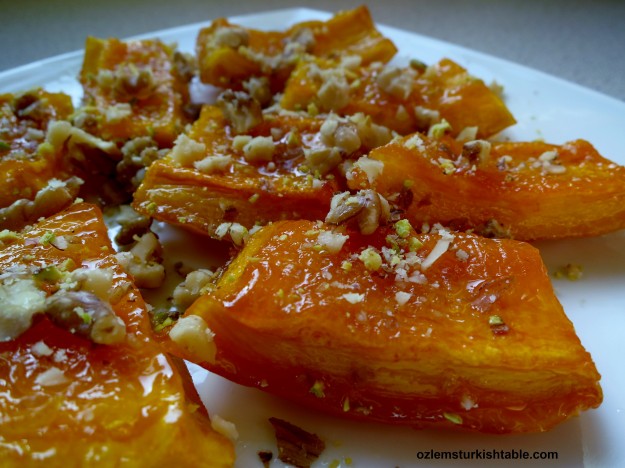
Luscious candied pumpkin dessert with crushed walnuts; Cevizli Kabak Tatlisi

Luscious candied pumpkin dessert with crushed walnuts; Cevizli Kabak Tatlisi

Let the pumpkin dessert cool down. Decorate the candied pumpkin pieces with crushed walnuts just before serving; you can serve this delicious dessert as this way or also with Turkish thick clotted cream, kaymak or regular clotted cream aside.

Afiyet Olsun,

Ozlem


Continue Reading

Broad beans dip with dill and red peppers; Kirmizi Biberli Fava

Bountiful, seasonal produce at the Farmer's Market, Pazar, in Istanbul; of one my favorite places to visit as soon as I am at home.

Bountiful, seasonal produce at the Farmers’ Market, Pazar, in Istanbul; of one my favorite places to visit as soon as I am at home.

I love this time of the year when all the fresh produce is at its best. Farmers’ Markets or Pazar, as we call it in Turkish, are packed with ripe juicy tomatoes (why not enjoy tomatoes in this Gavurdagi Salad of ripe tomatoes, walnuts with pomegranate molasses dressing), slim gorgeous aubergines /eggplants (try Imam Bayildi, eggplants cooked in olive oil with vegetables; a delicious and refreshing vegetarian course you can prepare ahead of time), watermelon, peppers and many more. Turkish cuisine is based on using fresh, seasonal produce and seeing these is a paradise on a plate for me.

Fresh broad beans; I love their earthy, delicious flavour

Fresh broad beans; I love their earthy, delicious flavour

 I was delighted to find fresh broad beans or fava beans in my local farmers market a few weeks ago. Fresh broad beans are available from late spring until about end of August. Broad beans were a staple food in ancient times and they are common in many Mediterranean and Middle Eastern cuisines today. They are very high in protein and fiber and naturally low in fat and cholesterol. I love their unique, earthy flavor, especially in this popular mezze in Turkey; Fava, Pureed broad beans with dill, lemon juice and olive oil. Traditionally, we use dried broad beans for this puree; this time I used fresh broad beans and it worked really well.

Broad beans puree with dill and sauteed peppers in olive oil; a delicious dip

Broad beans puree with dill and sauteed peppers in olive oil; a scrumptious dip

I especially loved the bright sweetness of the fresh broad beans in this appetizer. Blended with dill, olive oil and lemon juice, it turned out to be a delicious, earthy dip. It has a consistency of a thick hummus and is delightful on toasted bread or crackers. I served this dip with sautéed strips of red peppers in red pepper flakes (pul biber) infused olive oil; the sweetness of the peppers and the touch of spice from the red pepper flakes worked so well with the earthy flavor of the broad beans. As you can prepare ahead of time, it makes a lovely entertaining dish. This broad beans puree keeps very well in the fridge for a good few days.

Signed copies of Ozlem’s Turkish Table cookery book, available to order at this link

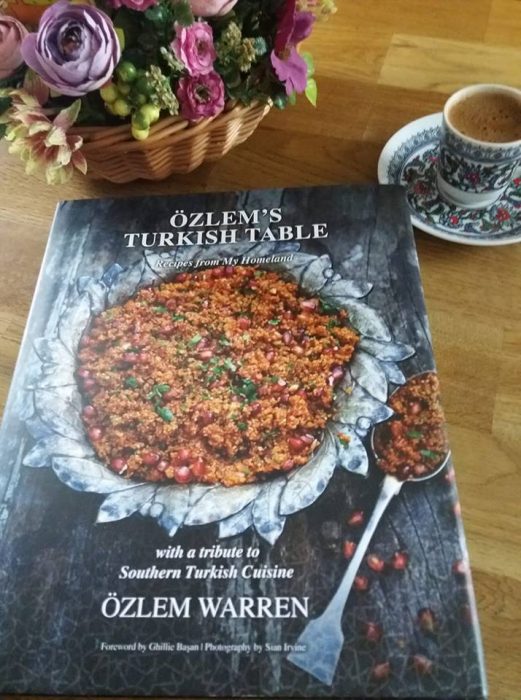
Turkish cuisine is based on seasonal produce and offers a wide range of vegetarian, vegan and gluten-free choices, very healthy and delicious too. I aimed to showcase our healthy Turkish cuisine with over 90 delicious, authentic dishes at my cookery book, Ozlem’s Turkish Table, Recipes from My Homeland; Signed copies available to order at this link, if you’d like. Please note that this recipe is not included at my current cookery book.

Serves 2 – 4

200 gr/ 7 oz./1  ¾   cups fresh broad beans, shelled (or a generous 1 cup dried broad beans)

1 small potato, cut in chunky cubes

1 small onion, roughly chopped

30 ml/ 2 tbsp. chopped fresh dill

5ml/ 1 tsp. brown sugar

Juice of 1 lemon

30ml/ 2 tbsp. extra virgin olive oil

Salt and freshly ground black pepper to taste

To serve:

1 small red bell (or pointy) pepper, deseeded and cut into thin stripes

30ml/2 tbsp. chopped fresh dill

30ml/ 2 tbsp. olive oil

5ml/1 tsp. Turkish red pepper flakes (pul biber)

fresh broad beans, onions and potatoes work well in this delicious dip

Fresh broad beans, onions and potatoes work well in this delicious dip

If you are using dried broad beans, place the beans in a bowl of water and soak overnight or for at least 4-6 for six hours. Drain beans and then cook them in boiling water with the potatoes and onions. Simmer for about 40-45 minutes, until tender. Once cooked, drain the water and set aside to cool.

If you are using fresh broad beans, blanch the shelled beans in boiling water for about a minute, then grasp them by the furrowed ends and slip them out of their skins.

In a small saucepan, add these broad beans, potatoes and onions, cook over medium heat until tender, about 15 to 20 minutes. Set aside to cool.

Pulse the cooked beans and vegetables with dill in a food processor to form a purée consistency.

Pulse the cooked beans and vegetables with dill in a food processor to form a purée consistency.

Pulse the cooked beans and vegetables with dill in a food processor to form a purée consistency. Remove from the food processor into a bowl and stir in olive oil, sugar and lemon juice. Season with salt and ground black pepper to your taste.

Broad beans and vegetables puree; chill and set in the fridge.

Broad beans and vegetables puree; chill and set in the fridge.

Just before serving, gentlyheat the olive oil in a pan and stir in the Turkish red pepper flakes. Add the stripes of red bell peppers, combine and cook for a few minutes. The red pepper flakes will infuse to the olive oil and turn into a lovely red color. Stir in the fresh dill and turn the heat off.

Once the broad beans puree is set in the fridge, unmold, turn the puree over on a serving dish. Drizzle the sautéed peppers and the olive oil over and around the pureed broad beans dip. You can enjoy this delicious dip with toasted bread or crackers aside.

Broad beans puree with dill and sauteed peppers in olive oil; a delicious dip

Broad beans puree with dill and sauteed peppers in olive oil; a delicious dip, great for entertaining.

Afiyet Olsun,

Ozlem

Tips for buying fresh fava (broad beans):

  • When purchasing fresh fava beans (or broad beans), look for bright green pods that are free of yellow patches. Large beans are starchy and firm, while smaller ones are sweeter and tenderer.
  • If you are buying shelled beans, make sure they are tender and have a smooth surface.
  • To store shelled fava beans, spread them out in a single layer and cover them loosely with plastic wrap for up to three days.


Continue Reading

Aubergines stuffed with onion, garlic and tomatoes in olive oil; Imam Bayildi

Imam Bayildi; eggplants, aubergines, stuffed with onions, garlic and tomatoes and poached in olive oil; just melt in the mouth

Imam Bayildi; eggplants, aubergines, stuffed with onions, garlic and tomatoes and poached in olive oil; just melt in the mouth

Patlican, eggplants or aubergines are one of the most popular vegetables (actually fruit, as it has seeds in it) in Turkey; we must have over 200 recipes showcasing our beloved patlican, eggplant. I love this classic Turkish dish, Imam Bayildi or “Imam Fainted”, one of the most popular eggplant dishes at home. Legend says  “Imam Fainted” either due to the shock or the pleasure at the quantity of the olive oil used in this dish! No doubt, eggplant loves olive oil and tastes so good in this Imam Bayildi.

Imam Bayildi; this delicious stuffed eggplants in olive oil is lovely vegetarian course, enjoyed at room temperature or cold

Imam Bayildi; this delicious stuffed eggplants in olive oil is lovely vegetarian course, enjoyed at room temperature or cold

The aubergines are gently poached in this dish with a generous mixture of onions, tomatoes and garlic. This dish is in the category of Vegetables cooked in olive oil, Zeytinyaglis in Turkish cuisine, where the vegetables are poached in olive oil and little water and served either cold or room temperature with a slice of lemon aside. It is delicious and refreshing for hot summer days, just melts in the mouth.

You can prepare Imam Bayildi ahead of time and the left overs can keep in fridge for 2-3 days. I used a little less olive oil here and added dried mint to the filling; the result was a light, utterly delicious and refreshing vegetarian course.

I am passionate about my homeland’s  healthy, delicious Turkish cuisine; over 90 authentic Turkish recipes are included at my cookery book, Ozlem’s Turkish Table, Recipes from My Homeland. Hardback copies are now 20 % off at this link with reduced shipping rates to the US, Canada and Mexico.

Serves 4

2 large (and slim, if possible) eggplants/aubergines

1 large onion, halved and finely sliced

3 tomatoes, finely chopped

3-4 garlic cloves, finely chopped

1 bunch of flat leaf parsley, finely chopped

60ml/4 tablespoons olive oil

Juice of ½ lemon

10ml/2 teaspoon sugar

5ml/1 teaspoon dried mint

Salt and black ground pepper to taste

Light olive oil (or canola oil) to shallow fry the eggplants/aubergines

Extra wedges of lemon to serve


Using a vegetable peeler, peel the aubergines lengthways in zebra stripes.

Using a vegetable peeler, peel the aubergines lengthways in zebra stripes.

Using a vegetable peeler, peel the aubergines length ways in zebra stripes, then cut the eggplants / aubergines in half lengthways. In each half of eggplant, cut a deep split length ways without cutting through to the skin on the opposite side and leaving 1/2″-13 mm- uncut at either end. Sprinkle salt (this will help the moisture come out) over the eggplants and leave for about 10-15 minutes to leach out the moisture and bitter juices of eggplants. After that, thoroughly drain and pat dry the eggplants with paper towel to get rid of this moisture, otherwise they will be soggy.

 Place the sauteed eggplants on a paper towel to absorb excess oil.

Place the sauteed eggplants on a paper towel to absorb excess oil.

Heat about 1cm/1/2in light olive oil or canola oil in a deep sided pan. Place the eggplants in the oil and shallow fry quickly on both sides until they are softened and have a light brown color, for about 3-5 minutes. Place paper towel on a tray and transfer these eggplants there; the paper towel will absorb the excess olive oil.

Dried mint brings a refreshing flavor to the filling of the eggplants.

Dried mint brings a refreshing flavor to the filling of the eggplants.

Now let’s prepare the filling. Stir in the sliced onions and garlic in a bowl, add 2 tablespoons of olive oil, dried mint, salt and ground black pepper to taste. Knead this mixture with your hands for the dried mint and seasoning to blend well (this will also help the onions to soften). Stir in the tomatoes and parsley to the mixture and combine well.

Lift the eggplants to a chopping board and open up the split in the middle to create pockets. Spoon the mixture into these eggplant pockets, packing it in tightly so that all of the filling is used up (if you have any left over filling, I would simply cook them in the same pan next to these eggplant pockets).

Spoon the filling mixture into the eggplant pockets.

Spoon the filling mixture into the eggplant pockets.

Place the stuffed eggplants side by side in a wide, heavy pan. Mix the remaining olive oil with ½ cup water, lemon juice and sugar and pour it over the eggplants.

Cover the pan with a lid and place over a medium heat to get the oil hot and create some steam. Once the cooking liquid is hot, cook the eggplants for about 45-50 minutes. Once cooked, they should be soft and tender, with a little of cooking liquid left in the bottom of the pan.

Leave Imam Bayildi; stuffed eggplants in olive oil to cool and rest in the pan after cooking.

Leave Imam Bayildi; stuffed eggplants in olive oil to cool and rest in the pan after cooking.

Leave the eggplants to cool and rest in the pan for the flavors to settle, then carefully transfer them to a serving dish and spoon the oil from the pan over the eggplants. Serve at room temperature or cold, with a wedge of lemon aside and extra garnish of parsley over them.

Imam Bayildi; eggplants, aubergines, stuffed with onions, garlic and tomatoes and poached in olive oil; just melt in the mouth

Imam Bayildi; eggplants, aubergines, stuffed with onions, garlic and tomatoes and poached in olive oil; a delicious vegetarian course, just melts in the mouth

Afiyet Olsun,

Ozlem

Tips for buying eggplants: Although these days eggplants are available all year around, July, August and September are their prime time.  When buying, choose eggplants with smooth, shiny skin, heavy for their size, and having no blemishes, tan patches, or bruises. Wrinkled, loose skin is an indication of age, and the fruit will be more bitter. Smaller eggplants have fewer seeds, thinner skin, and tend to be sweeter, tenderer and less bitter.

Continue Reading