
Cookery Classes

I teach Turkish cooking classes in England,Turkey & USA, hope you can join us!,
Find Out More

Recipes    

Turkish cuisine provides healthy, hearty, delicious food for family and friends.
Find out more

Vegetarian recipes

Beetroot with Olives, Toasted Hazelnuts and Pul Biber Oil

I am excited to share with you, one of my favourite recipes at my new cook book, ISTANBUL – it is Beetroot with Olives, Toasted Hazelnuts and Pul Biber Oil, Zeytinli, Fındıklı, Pul Biber Soslu Pancar. Everyone I serve love this, even dear Nigella Lawson is a fan.

Beets with toasted hazelnuts, olives, pul biber oil from Istanbul cookery book, image by Sam A Harris

We love pancar (beetroot) and great big bunches of it can be found in our pazar (farmers markets) in İstanbul. The modern eateries and cafés of the city also serve it in salads, usually cooked and then dressed in oil and vinegar, but sometimes grated and mixed with yoghurt too. Inspired by this, I combined cooked beetroot with briny green olives and crunchy, toasted hazelnuts, ingredients that bring layers of flavour and texture to this easy meze. The nar ekşisi (pomegranate molasses) in the dressing adds a natural sweet-and-sourness that goes well with the beetroot, complementing both the cooling yoghurt and the heat of the pul biber oil. You can replace the hazelnuts with your choice of nuts, if you wish.

Prepare ahead This is a great one to make ahead, as the flavours develop as it sits. You can make it a day ahead and keep in the refrigerator, covered. Drizzle the pul biber oil just before serving.

I hope you enjoy my recipe, from ISTANBUL cookery book. Over 85 delicious, easy to make flavours from Istanbul included in the book (over 50 of them vegetarian too), along with stunning design and photography. You can get a copy here

Afiyet Olsun,

Ozlem x

Beetroot with Olives, Toasted Hazelnuts and Pul Biber Oil
 
We love pancar (beetroot) and great big bunches of it can be found in our pazar (farmers markets) in İstanbul. The modern eateries and cafés of the city also serve it in salads, usually cooked and then dressed in oil and vinegar, but sometimes grated and mixed with yoghurt too. Inspired by this, I combined cooked beetroot with briny green olives and crunchy, toasted hazelnuts, ingredients that bring layers of flavour and texture to this easy meze. The nar ekşisi (pomegranate molasses) in the dressing adds a natural sweet-and-sourness that goes well with the beetroot, complementing both the cooling yoghurt and the heat of the pul biber oil. You can replace the hazelnuts with your choice of nuts, if you wish.
Author:
Recipe type: Vegetarian Meze
Cuisine: Turkish Cuisine
Serves: 6
Ingredients
  • 650 g (1 lb 7 oz) beetroot (beets) - raw or pre-cooked-
  • 4 spring onions (scallions), trimmed and finely chopped 85 g (3 oz) stoned (pitted) green olives, halved
  • 55 g (2 oz) shelled hazelnuts, coarsely chopped
  • small handful parsley, finely chopped
  • For the garlic yoghurt:
  • 1 small garlic clove, finely chopped
  • 170 g (6 oz) full fat Turkish or Greek yoghurt (use a plant-based version, if preferred)
  • For the dressing:
  • 2 tablespoons extra virgin olive oil
  • 30 ml (1 fl oz) nar ekşisi (pomegranate molasses)
  • 1 tablespoon lemon juice
  • For the pul biber oil:
  • 2 tablespoons olive oil
  • ½ teaspoon pul biber (Aleppo pepper)
  • salt and freshly ground black pepper
Instructions
  1. Take the yoghurt out of the refrigerator about 45 minutes before serving to bring to room temperature. Stir in the garlic, season with salt and set aside.
  2. If you prefer to cook your beetroot, wash, trim and pat dry. Wrap each beetroot in foil (first cutting small beetroot in half lengthways and large ones into quarters), place on a baking tray (pan) and bake in an oven preheated to 200˚C fan/220˚C (425˚F) for about an hour. Allow to cool before carefully peeling the skin and cutting into 5 mm (1/4 in) thick slices.
  3. If using pre-cooked beetroot, drain the excess juice from the package, halve any large beetroot, then cut into 5 mm (1/4 in) thick slices.
  4. Place the beetroot in a bowl, add the spring onions and olives and combine well.
  5. Toast the hazelnuts in a small, dry pan set over a medium heat for 2½ –3 minutes, until they start to turn golden, stirring often. Remove from the heat and set aside.
  6. Pour the extra virgin olive oil, pomegranate molasses and lemon juice into a small bowl, season with salt and pepper and give everything a good mix with a small spoon.
  7. Pour the olive oil into a small pan, stir in the pul biber (Aleppo pepper) and allow to infuse over a low heat for about 45 seconds.
  8. Stir most of the toasted hazelnuts into the beetroot mixture, reserving some for garnish. Pour over the dressing, combine well, then spoon onto a wide serving dish and top with dollops of the yoghurt, swirling it to reveal the lovely shades of pink and red. Sprinkle with the reserved hazelnuts and the parsley, and drizzle over the pul biber oil.


Continue Reading

Kaygana Crêpes with Parsley and Spring Onions

Pancake day is round the corner, and I wanted to remind you our delicious, savoury Kaygana crepes, from my new book SEBZE, Vegetarian recipes from my Turkish kitchen.

These fragrant, savoury crêpes are a popular breakfast, especially in the Black Sea region and the northeastern part of Turkey. It’s a cross between an omelette and a Western-style crêpe and each region, almost each house, has their own version. In the Black Sea region chopped anchovy might be added; some may have it less eggy, some may add more herbs, garlic or spring onions (scallions). In the city of Trabzon, traditionally kaygana can be made using water instead of milk; plain (wheat) flour could be substituted with corn (maize) flour, too. We absolutely love these crepes with my Kuru İncir Reçeli (dried fig jam) from SEBZE, with thin slices of mature Cheddar (or Turkish kaşar cheese) on the side if you like.

SEBZE, Vegetarian Recipes From My Turkish Kitchen

SEBZE, Vegetarian Recipes From My Turkish Kitchen

Here is my recipe; you can get a copy of my book SEBZE  here worldwide, too.

Afiyet Olsun,

Ozlem

Kaygana Crêpes with Parsley and Spring Onions
 
These fragrant, savoury crêpes are a popular breakfast, especially in the Black Sea region and the northeastern part of Turkey. It’s a cross between an omelette and a Western-style crêpe and each region, almost each house, has their own version. In the Black Sea region chopped anchovy might be added; some may have it less eggy, some may add more herbs, garlic or spring onions (scallions). In the city of Trabzon, traditionally kaygana can be made using water instead of milk; plain (wheat) flour could be substituted with corn (maize) flour, too.
Author:
Recipe type: Vegetarian crepes
Cuisine: Turkish cuisine
Serves: 5
Ingredients
  • 255 ml (8½ fl oz/1 cup) full-fat milk
  • 165 g (5½ oz/11/3 cups) plain (all-purpose) flour
  • 4 medium eggs, beaten
  • small handful of flat-leaf parsley, finely chopped
  • 3 spring onions (scallions), trimmed and finely chopped
  • sea salt and freshly ground black pepper, to taste
  • 2 tablespoons melted unsalted butter
Instructions
  1. Combine the milk and flour in a large mixing bowl and whisk until you reach a smooth consistency. Pour in the beaten eggs and whisk again until well combined. Stir in the chopped parsley and spring onions, season with salt and pepper and combine well.
  2. Brush a wide, non-stick, 25 cm (10 in) frying pan (skillet) with the melted butter and heat over medium–high heat. Pour a ladle of the kaygana batter into the pan and swirl it around so the bottom of the pan is evenly coated in a thin layer. Cook over a high heat for about 45 seconds–1 minute on one side until golden. Use a wide spatula to flip the crêpe over and cook the other side for 30–45 seconds, until darkish golden blobs appear. Transfer to a serving plate.
  3. Cook the rest of the kaygana this way, brushing the pan with melted butter each time. Roll the crêpes into individual rolls and place side by side on a serving plate.
 

Continue Reading

Exclusive recipe from my new cookery book SEBZE – Turkish Şakşuka

Merhaba dear All,

It’s not long now for the worldwide publication of my new cookery book, SEBZE, Vegetarian recipes from my Turkish kitchen in April 2024 and I am giddy with excitement to share this special book with you all. You can pre-order your copy here, and we would greatly appreciated, as pre-orders help new books greatly.

There are 85 scrumptious vegetarian Turkish recipes in SEBZE. We have a rich and diverse regional cuisine, which I have researched extensively. SEBZE includes lesser-known regional specialties along with popular Turkish recipes and a few of my own creations. Many of the recipes complement one another and leftovers can be repurposed for other delicious meals with ease. There are plenty, easy one pot recipes, as well as recipes that suit gluten-free and plant-based diets too.

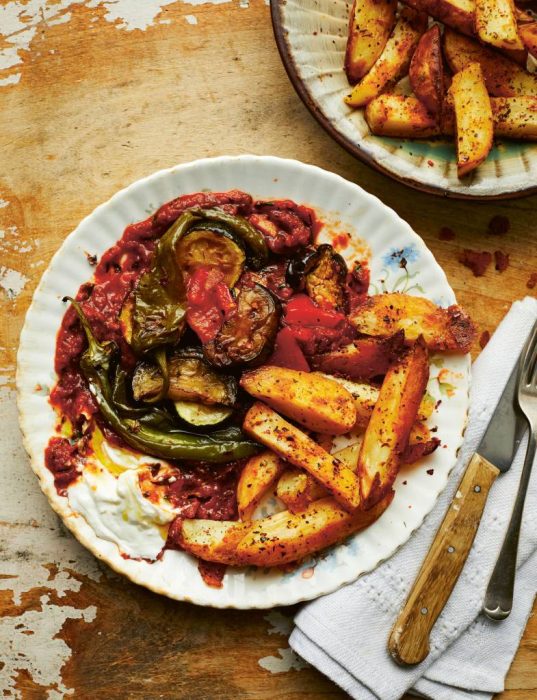
I wanted to share with you dear readers, an exclusive recipe from my new cookery book, SEBZE, Turkish Şakşuka; Baked Aubergines, Courgettes, Peppers with Tomato Sauce.

You might know Shakshuka (meaning ‘all mixed up’) as a popular dish in the Middle East of eggs cooked in tomato sauce, peppers, herbs and sometimes onions. For us Turks, though, the name and dish Şakşuka refers to this delicious, summery meze of aubergines (eggplant) and peppers cooked in olive oil, served with a tomato-based sauce. Vegetables are traditionally shallow-fried in olive oil for this recipe, although for a lighter and equally tasty option, I prefer to bake them in the oven. I added courgettes (zucchini) here too, following my mother’s recipe.

I suggest to serve this with the nutty Muhammara  and Kekikli, Pul Biberli Fırın Patates, my Baked potato chips with pul biber and oregano, both from SEBZE; they complement Şakşuka like a dream.

Turkish Şakşuka; Baked Aubergines, Courgettes, Peppers with Tomato Sauce

Prepare ahead: You can prepare Şakşuka a day ahead and keep covered in the refrigerator.

 Serves 2–3

 1 large aubergine (eggplant), partially peeled in stripes and trimmed

1 medium courgette (zucchini), cut into 1 cm (½ in) slices

1 red (bell) pepper, deseeded and cut into 3 cm (1 in) chunks

2–3 chillies or Turkish sivri biber, deseeded and sliced in half lengthways

4 tablespoons olive oil

sea salt and freshly ground black pepper, to taste

flatbreads, to serve

For the tomato sauce

1 tablespoon olive oil

3 garlic cloves, crushed with salt and finely chopped

400 g (14 oz) tin chopped tomatoes

2 teaspoons Turkish red pepper paste (biber salçası, see page xx for homemade) (or double concentrated tomato paste, for a milder flavour)

½ teaspoon pul biber or red pepper flakes (optional)

small handful of flat-leaf parsley, finely chopped

sea salt and freshly ground black pepper, to taste

For the garlicky yoghurt sauce

200 g (7 oz/generous ¾ cup) thick and creamy plain yoghurt (or plant-based alternative)

2 garlic cloves, finely chopped

sea salt and freshly ground black pepper, to taste

Preheat the oven to 200°C fan/220°C/425°F/gas 7.

Cut the peeled aubergine in half lengthways, then cut each half into 1 cm (½ in) slices. Place them on a large tray, sprinkle with salt and set aside for 10 minutes. Salt will help the moisture come out of the aubergines. Dry thoroughly with paper towels.

On a large baking tray, arrange the aubergine slices with the sliced courgette, pepper and chillies on the tray in one layer. Coat with olive oil and season with salt and pepper. Rub the seasoning and oil into the vegetables with your hands. Bake in the oven for 20 minutes. Remove the tray from the oven, remove the pepper strips and place on a large serving plate. Turn the aubergine and courgette slices and bake for a further 10 minutes until charred at edges and cooked through. Place alongside the peppers on the serving plate.

While the vegetables are baking, make the tomato sauce. Heat the olive oil in a wide pan over a medium heat, add the garlic and sauté for a minute, then add the chopped tomatoes and the pepper paste (or double concentrated tomato paste) and mix well. Cook for 3–4 minutes until the sauce thickens. Stir in the pul biber (if using) and the parsley. Season with salt and pepper to taste and remove from the heat.

For the yoghurt sauce, beat the yoghurt with the garlic and season to taste with salt and pepper.

Spoon the tomato sauce over the top of the cooked vegetables. Serve with the yoghurt sauce on the side, accompanied by flatbreads to mop up the tasty sauce.

Ozlem at Meric Ciftligi – Altinouzu, Antakya, from SEBZE. Image credit Sam A Harris

SEBZE  is a recipe collection built with convenience and flavour in mind, inspired by my homeland’s rich and diverse culinary heritage. I hope you will embark on a culinary journey to my homeland, to discover a selection of delightful, achievable vegetarian recipes, with stunning food and location photography.

From my kitchen to yours – Afiyet Olsun, as we say in Turkish – may you be happy and healthy with this food and enjoy your copy of SEBZE.

Continue Reading