Recipes    

Turkish cuisine provides healthy, hearty, delicious food for family and friends.
Find out more

Cookery Classes

I teach Turkish cooking classes in England,Turkey & USA, hope you can join us!,
Find Out More

Gozleme; Anatolian Flat breads stuffed with Spinach and Cheese

“Can we learn how to make gozleme (Anatolian stuffed flat breads) at the next class?” asked one of my regular Turkish cooking class  participants, few months ago. I greatly enjoy their requests, enthusiasm to learn more and have a go at them; that’s all I could hope for from the classes. “Sure, why not!” was reply; I was excited and my heart was set on tackling the much loved gozleme, Turkish flat breads with stuffing, the proper way. During my recent visit to Turkey, I got myself a proper non-stick oval gozleme pan to have a go at these delicious treats.

Local ladies preparing Gozleme at Hanimeli Restaurant, near Sirince - Turkey

Local ladies preparing Gozleme at Hanimeli Restaurant, near Sirince – Turkey

Having said that, the prospect of preparing Gozleme from scratch; preparing the dough and opening, stretching the dough as thin as sheets of paper was a little daunting at first. I call myself a cook more than a baker and greatly admire local ladies making it so effortlessly at home, in Turkey. Could I tackle it, I wondered. Thank goodness the sheer excitement of having a go at gozleme weighed much higher and I am so glad I tried. The sheets stretched beautifully and gozleme tasted heavenly. I owe a big thank you to David for the inspiration and that precious request!

Gozleme is traditionally prepared on giant non-stick round pan

Gozleme is traditionally prepared on giant non-stick round pan

We Turks love these stuffed flat breads, gozleme. Turks were originated from Central Asia, where they drifted towards Anatolia gradually and made their home. They have been making these stuffed flat breads since then. Gozleme is a much loved Turkish street food and a special part of the delicious Turkish breakfast.  These popular snacks are cooked quickly on a hot griddle and can be filled with various fillings. Some of my favorite fillings are mashed potatoes, cheese and parsley; spinach and cheese, and ground meat and onions. And they go down very well with a glass of cay, Turkish tea or ayran, traditional Turkish yoghurt drink.

My Ispanakli & Peynirli Gozleme - Anatolian Flat breads with cheese, onion and spinach, indeed easier than you think!

My Ispanakli & Peynirli Gozleme – Anatolian Flat breads with cheese, onion and spinach, indeed easier than you think!

In the filling in this recipe I added a little Turkish red pepper paste, biber salcasi to the filling for a spicier version; it flavored the spinach and onion really well. If you would like a milder taste, simply omit the red pepper paste (or the pepper flakes).

Here is also my YouTube video link for How to make Home Style Gozleme:
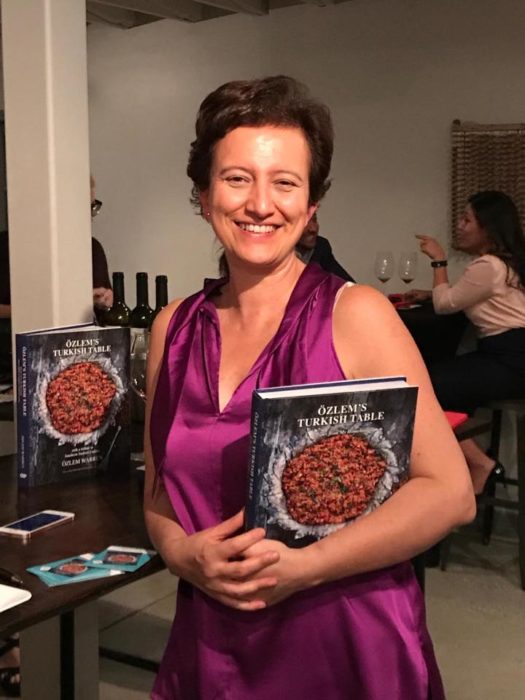
Gozleme, Pide and savoury pastry recipes are also included in my Gourmand award winner cookery book Ozlem’s Turkish Table, signed copies of Ozlem’s Turkish Table, Recipes from My Homeland, now 20 % OFF available to order at this link. It is delivered worldwide; now with lower shipping rates to the US, Canada and Mexico at this link.

Makes about 5 Gozleme

1lb./ 16 oz. / 3 cups plain flour

8g / 1 sachet instant dried yeast

Pinch of salt

45 ml/ 3 tbsp. olive oil

30 ml / 2 tbsp. plain natural yoghurt (preferably whole milk)

260 ml/ 9 fl. oz. / 1/5 cups warm water (150 ml/ 5 fl. oz. warm water to be mixed with the yeast)

For the filling:

200gr/7 oz. baby spinach leaves

1 onion, finely chopped
5ml/1 teaspoon Turkish red pepper flakes or 2 tsp. Turkish red pepper paste (optional)
230gr/8oz feta cheese

15ml/1 tbsp. olive oil

Non-stick pan or griddle to cook the Gozleme

Combine about 150 ml/ 5 fl. oz. warm water, yeast and salt in a small bowl, stir and cover. Stand in a warm place for 5 minutes or until bubbles form on the surface.

Divide the gozleme dough into balls, cover with a damp cloth and leave them to rest for 30 minutes,

Divide the gozleme dough into balls, cover with a damp cloth and leave them to rest for 30 minutes.

Sift the flour into a large bowl. Make a well in the middle and pour in the yeast, water & salt mixture, olive oil, yoghurt and the remaining warm water (about 110 ml/ 4 fl. oz./ ½ cup) . Using your hand, draw in the flour from the sides and work the mixture into a dough. Knead thoroughly to form a soft dough. Divide the dough into 5  pieces, knead them and roll into balls. Place the balls on a floured surface, cover with a damp cloth and leave them to rest for about 30 minutes, or until the dough doubles in size.

Knead the onions, spinach, olive oil and if you are using, red pepper paste first with your hands; that will soften the onions and blend the flavors well.

Knead the onions, spinach, olive oil and if you are using, red pepper paste first with your hands; that will soften the onions and blend the flavors well.


 Stir in the feta cheese to the spinach mixture and combine well.

Stir in the feta cheese to the spinach mixture and combine well.

Meanwhile, prepare the filling. Chop the washed spinach leaves roughly. Knead the onions, spinach, olive oil and if you are using, red pepper paste (or red pepper flakes) with your hands for a few minute or so – that will soften the onions and blend the flavors well -. Stir in the feta cheese and combine well.

Roll the gozleme dough with a rolling pin until you achieve a thin sheet of a flat round.

Roll the gozleme dough with a rolling pin until you achieve a thin sheet of a flat round.

 On a lightly floured surface, roll out each of the balls of the dough with a rolling pin into thin, flat rounds, about 40cm/16in diameter. Sprinkle a little flour as you roll the dough so that the dough won’t stick. Roll until you achieve a thin sheet of a flat round.

Fold the left and right sides of the dough in a way for the edges to meet in the middle and spread the filling in the middle.

Fold the left and right sides of the dough in a way for the edges to meet in the middle and spread the filling in the middle.


Then fold the top and bottom edges over the filling, making sure all the filling is safely covered.

Then fold the top and bottom edges over the filling, making sure all the filling is safely covered.


Fold the left and right sides of the dough in a way for the edges to meet in the middle.  Spread about 2 ½ tablespoon filling into the middle part of this flat sheet. Then fold the top and bottom edges over the filling, making sure all the filling is safely covered. Press edges together well to seal. Repeat the same procedure for the rest of the dough balls.

Brush one side of the gozleme with a little olive oil and place on the pan to cook for about 2 -3 minutes, or until golden brown.

Brush one side of the gozleme with a little olive oil and place on the pan to cook for about 2 -3 minutes, or until golden brown.

Heat a griddle or a non-stick pan, and brush one side of the gozleme with a little olive oil and place on the pan to cook for about 2 -3 minutes, or until golden brown. Brush the uncooked side with a little olive oil and then flip it over. Cook for another 2-3 minutes, until golden brown.

Cook the gozleme for about 2 -3 minutes on a non-stick pan, or until golden brown.

Cook the gozleme for about 2 -3 minutes on a non-stick pan, or until golden brown.

Brush both cooked sides of gozleme with a little olive oil -this will keep the gozleme moist. Cook the rest of the gozleme the same way.

My Ispanakli & Peynirli Gozleme - Anatolian Flat breads with cheese, onion and spinach, indeed easier than you think!

My Ispanakli & Peynirli Gozleme – Turkish Flat breads with cheese, onion and spinach stuffing; they are indeed easier than you think!

You can either roll the Gozleme to serve, or you can cut in halves or quarters. Ayran Turkish yoghurt drink or  Turkish tea, cay would go really well next to Gozleme.

Afiyet Olsun,

Ozlem


Continue Reading

An Emotional, Poignant Moment at Dardanelles, Gallipoli ; Anzac Day

Have you ever tried hummus warmed up? In Turkey, especially in the South, hummus is served warm with sautéed Turkish sucuk (sausage) – or pastirma (pastrami) or with sautéed pine nuts over the top. I strongly suggest you to try hummus this way, as I feel you may be pleasantly surprised and maybe converted to eat hummus warm as many of my friends have done.

Warm hummus with sauteed Pastrami (Pastirma, Turkish dried cured beef) - the flavors complement each other so beautifully.

Warm hummus with sauteed Pastrami (Pastirma, Turkish dried cured beef) – the flavors complement each other so beautifully.

Please adjust the recipe according to your taste, as some like it garlicky, some with more tahini and others may prefer it more lemony. In my recent Turkish cooking class, I added the sautéed pastrami, pastirma, over warm hummus, as it is served in traditional kebab houses in Turkey. Pastirma is a dried cured beef coated with spices and has a delicious, rich flavor. The  hummus and the spice coated pastrami has complemented each other so beautifully here. If you can’t get Turkish pastrami, you can use the Italian pastrami or your favorite cured meat or grilled meat.

Warm hummus with red pepper flakes infused olive oil - a delicious vegetarian dip.

Warm hummus with red pepper flakes infused olive oil – a delicious vegetarian dip.

This warm hummus would make a wonderful appetizer to share with friends and family and goes so well with grilled vegetables or meat by the side. For a vegetarian option, you can serve the warm hummus with red pepper flakes infused olive oil, this one is so delicious too. Both these options may also be wonderful addition for the Mother’s Day spread, if you are celebrating. Pita bread is the perfect accompaniment – hope you enjoy it.

Serves 4-6

Preparation time – 15 minutes (add 1 hour if used dried chickpeas and soaking overnight)

225gr/8oz dried chickpeas or garbanzo beans, soaked in water overnight or for at least 6 hours or equivalent amount of precooked chickpeas in can

5ml /1 teaspoon salt – please adjust according to your taste-
60ml/4 tablespoons extra virgin olive oil
30ml/2 tablespoons water
2 garlic cloves, crushed – optional-
Juice of 1 lemon
30ml/2 tablespoon tahini (sesame paste)
5ml/1 teaspoon ground cumin

To serve:
30ml/2 tablespoons olive oil
1/2 teaspoon red pepper flakes
1/2 teaspoon ground cumin
110gr/4oz Turkish Pastirma, chopped in 1″ strips (or your choice of any Pastrami or sausage)

Slices of pita bread to serve

If using dried chickpeas (garbanzo beans), drain the chickpeas and transfer them to a pan with plenty of cold water. Bring to boil and boil for a few minutes. Then lower the heat and partially cover the pan, Simmer the chickpeas for 1 hour, until they are soft and easy to mash.

If precooked chickpeas are used, drain the juice and give them a little wash in a colander. Put the precooked (or cooked) chickpeas in a food processor and blitz them together with the extra virgin olive oil, water, lemon juice, garlic and tahini. If it appears thick and difficult to blend, add a little more olive oil or water. Season with salt and mix in the cumin and red pepper flakes (if desired). Process until you achieve a soft, smooth paste. Refrigerate until required.

Warm hummus with sauteed pastrami; makes a delicious appetizer and goes well with grilled vegetables and meat.

Warm hummus with sauteed pastrami; makes a delicious appetizer and goes well with grilled vegetables and meat.

Just before serving, add a splash of olive oil and heat the hummus in a pan for a couple of minutes. In a separate pan, sauté the strips of pastrami in olive oil. Place the warm hummus in a plate with the sautéed meat over the top, scattering some ground cumin and red pepper flakes over. Serve immediately with slices of pita or flat bread by the side.

We all enjoyed the warm hummus as part of our Turkish cookery class at Istanbul Culinary Institute.

We all enjoyed the warm hummus as part of our Turkish cookery class at the Istanbul Culinary Institute.

Afiyet Olsun,

Ozlem 

Strolling Through the Battlefields of Gallipoli – Dardanelles

Driving towards Canakkale, we saw bountiful fig trees, just beautiful.

Driving towards Canakkale, we saw bountiful fig trees, just beautiful.

Our culinary and cultural tour to Turkey  has almost come to an end; going to Gallipoli  and visiting the battlefields  near the Dardanelles has been a highlight to many folks and did provide a reflective, emotional moment.

Ferry trip from Canakkale to Gallipoli, Gelibolu.

Ferry trip from Canakkale to Gallipoli, Gelibolu.

GallipoliGelibolu is a peninsula in North-west Turkey, close to Istanbul. The Gallipoli Peninsula is the site of extensive First World War battlefields and memorials on the north bank of the Dardanelles Strait. You can take the ferry from Canakkale to go to Gallipoli like we did, it is easy and convenient.

A surprising and emotional moment, hearing the locals singing  Gallipoli folk songs at the ferry.

A surprising and emotional moment, hearing the locals singing Gallipoli folk songs at the ferry.

While on the ferry, all of a sudden we saw a group of locals gathered at the deck, singing Canakkale Turkusu, Gallipoli Folk Song whole heartedly. I remembered singing this folk song as a child, it was a surreal and an emotional moment, we all joined in.

The impressive Gallipoli Kabatepe Museum, well worth visiting

The impressive Gallipoli Kabatepe Museum, well worth visiting

The impressive  Gallipoli Kabatepe Museum (or Gallipoli War Museum) was recently opened and so well worth a visit. It has 11 gallery rooms, each equipped with advanced high-tech simulation equipment and the technology allows visitors to choose their presentation language and interact with the display. The centre houses an extensive collection of historic items relating to the renowned World War I campaign and we have been told that the simulations are so real.

Private belongings of the soldiers neatly preserved and displayed at Gallipoli Kabatepe (War) Museum

Private belongings of the soldiers neatly preserved and displayed at the Gallipoli Kabatepe (War) Museum

Gallipoli Kabatepe Museum hosts numerous relics from the campaign including weapons, uniforms, ammunition, letters written by soldiers to their families, photographs, and private belongings such as shaving tools, cocoa tins and cutlery. A very poignant and emotional moment to view and get so near to each piece.

Ariburnu Cemetery at Ariburnu Beach, Gallipoli

Ariburnu Cemetery at Ariburnu Beach, Gallipoli

We then drove up to the Ariburnu Cemetery, at the beautiful Ariburnu Beach. The Ariburnu Cemetery is situated on the north edge of ANZAC Cove by the shore where the Anzacs first landed on 25 April 1915. We were told that 253 Allied soldiers rest in the cemetery; it was very emotional visiting the graves. It is such a peaceful spot and may all those souls rest in peace.

The Ariburnu Memorial, Ataturk's wonderful epitaph is a stone monolith beside the Ariburnu Cemetery

The Ariburnu Memorial, Ataturk’s wonderful epitaph is a stone monolith beside the Ariburnu Cemetery

Mustafa Kemal Ataturk,  the extraordinary leader and founder of today’s Turkey, wrote a tribute to the ANZACs who  lost their lives at Gallipoli. This wonderful tribute inscribed in English on the monolith are the famous words Mustafa Kemal Ataturk delivered in 1934 to    the first Australians, New Zealanders and the British to visit the Gallipoli battlefields. I absolutely loved and embraced it:

Those heroes that shed their blood
And lost their lives…
You are now lying in the soil of a friendly Country.
Therefore rest in peace.
There is no difference between the Johnnies
And the Mehmets to us where they lie side by side
Here in this country of ours…
You, the mothers,
Who sent their sons front far away countries
Wipe away your tears,
Your sons are now lying in our bosom
And are in peace
After having lost their lives on this land
They have become our sons as well

Our dear driver with his favorite wild ivy hand picked in Gallipoli

Our dear driver with his favorite greens, Sarmasik, Wild Ivy hand picked in Gallipoli

Just as we have been reflecting on what we’ve seen on Ariburnu Cemetery, our dear driver, Mehmet Bey excited came forward to show the wild greens he just picked up by the side road’ “Ozlem Hanim” he said “ these are the best Sarmasik  (Wild Ivy) you can get. I will sauté with garlic and crack my eggs into it tonight, delicious!” Being from the Aegean region, I know how much Mehmet Bey loves the fresh, wild greens – food managed to bring similes to face again.

And off we set towards Istanbul, looking forward to the buzz of the city and that baklava class..

Continue Reading

Pomegranate juice, the frothiest of Ayran (Turkish yoghurt drink), Meatballs with potatoes and peppers and More – Fascinating Pergamum and Its Culinary Delights

Always have time to stop; ispanakli borek- spinach pastry and simit with cheese, of course with cay

” Always have time to stop; ispanakli borek- spinach pastry and simit with cheese, of course with cay at a motorway cafe neat Pergamum, Turkey

“Time to stop for cay – Turkish tea- and refreshments!”, announced our tour guide on our way to the ancient Pergamum or Pergamon, near by the city of  Bergama in Turkey. As much as I looked forward to going back to Pergamum, this  announcement was music to our ears, as every stop we had in Turkey produced delicious treats. We stopped at a modest local cafe by the side of the motorway and indulged in these freshly baked simits, pastries filled with spinach and cheese; we divided the pastries between us happily and washed down with a glass of cay. Each stop has been full of delicious gastronomic experiences during our tour and the journey to Pergamum  was no exception, providing a lot of culinary delights.

Freshly squeezed nar suyu, pomegranate juice - delicious and packed with goodness.

Freshly squeezed nar suyu, pomegranate juice – delicious and packed with goodness.

Have you ever had freshly squeezed pomegranate juice? Right by the entrance of Pergamum, lined delicious food and drink stalls, and we shared a glass – so refreshing and punchy, packed with goodness and flavour.

Bulgur wheat salad with pomegranate molasses, olive oil and vegetables - Kisir

Bulgur wheat salad with pomegranate molasses, olive oil and vegetables – Kisir

Pomegranates feature often in Turkish cuisine. We use the thick & delicious pomegranate molasses sauce in Bulgur wheat salad, Kisir, a specialty in the southeast of Turkey, from where the country’s spicier dishes hail. Kisir is offered as a welcome to the guests in the homes of Antakya, where my roots are from, and in Gaziantep.  It can be rolled into balls and served nestling in crunchy lettuce leaves. This dish is perfect for buffets or as part of a barbecue spread. It really is a “bowl of health and goodness” with fresh vegetables, bulgur – packed with fiber – and pomegranate sauce, full of antioxidants. This delicious vegetarian salad tastes even better the next day!

Turkish ice cream - kaymakli dondurma, a specialty from Maras region in Southeast

Turkish ice cream – kaymakli dondurma, a specialty from Maras region in Southeast


Some of the folks couldn’t resist the wonderfully thick Turkish ice cream, “Maras Dondurmasi”. As the name says, it is a specialty from the Maras region in Southeast Turkey; very tasty and thick that you can actually slice with a knife and eat with your fork.

Delicious spread at Altin Kepce, Bergama

Delicious spread at Altin Kepce, Bergama


But above all, it was our lunch stop at the local eatery, Altin Kepce (translated as “Golden Ladle” in English) in Bergama that stole our hearts. A small, family owned restaurant tucked in at the side road, where locals, traders, villagers congregate for lunch; it is buzzing and their freshly prepared, generous food ever delicious. Some enjoyed the Kuru Fasulye- Turkish dried beans casserole with vegetables, and some tried the Zeytinyagli Patlican – Eggplants cooked in olive oil with vegetables or their famous koftes, meatballs.

Meatballs with peppers and potatoes, eggplants cooked in olive oil and the ayran (Turkish yoghurt drink) - a delicous feast.

Meatballs with peppers and potatoes, eggplants cooked in olive oil and the ayran (Turkish yoghurt drink) – a delicous feast.

I opted for a mixed plate of eggplants cooked in olive oil and the Turkish meatballs with potatoes and peppers, it was a delicious feast with the frothiest of Ayran, Turkish yoghurt drink.


Here is my recipe for the popular meatball and vegetable casserole (not only with the children but with the adults too!) that can either be cooked on the stove top or baked in the oven. It makes a complete and hearty main course served with plain white rice or a slice of crusty bread. This is Izmir Kofte my way, as I like to add some more vegetables. You can add as much red pepper flakes as you would like for a spicier flavor.


Casserole of meatballs, potatoes, peppers in tomato sauce - Izmir Kofte, my way

Casserole of meatballs, potatoes, peppers in tomato sauce – Izmir Kofte, my way


 Ayran – A refreshing tradional yoghurt drink

The frothiest, refreshing Ayran, Turkish yoghurt drink at Altin Kepce, Bergama.

The frothiest, refreshing Ayran, Turkish yoghurt drink at Altin Kepce, Bergama.

Have you ever tried our traditional drink Ayran? Ayran is a mixture of plain natural yoghurt (preferably whole milk), water and a pinch of salt blended together, similar to buttermilk. To make ayran, blend 2 cups of plain yoghurt with 1 cup water with a pinch of salt, for about 20 seconds. You will see a nice thick foam and bubbles formed at the top. Serve in water glasses with a few ice cubes in them. You may also add a few fresh mint leaves for a refreshing taste. Ayran is a popular drink at home, especially with kebabs and casseroles, and it would go well with this casserole too.

Delicious Kemalpasa dessert at Altin Kepce with thick clotted cream, kaymak at top

Delicious Kemalpasa dessert at Altin Kepce with thick clotted cream, kaymak at top

Our feast at Altin Kepce – Bergama ended with the delicious, met-in-the-mouth Kemalpasa dessert.  The dessert takes its name  from the name from the town of Kemalpasa, part of the city of Bursa. And the town takes its name from the founder of Republic of Turkey, the great leader Mustafa Kemal Atatürk. This dessert contains a special cheese produced in this town, though you can substitute with a mild, unsalted white cheese like mozarella. You can buy the precooked cookies of the Kemalpasa dessert sold in packages all around Turkey and all you need to do is to prepare the sherbet to soak them in. Apparently this dessert has such a significant role in the life of the town that there is even a Kemalpasa dessert festival on September 14th.  Zerrin from Give Recipe has a fabulous Kemalpasa recipe, if you would like to have a go.

 Pergamum in spring, covered by daisies

We finally made it to Pergamum in a beautiful spring day. Built on a conical hill rising 1,000 feet above the surrounding valley, Pergamum (also spelled Pergamon, from the Greek for “citadel”) was an important capital city in ancient times. Its modern successor is the Turkish city of Bergama and this magnificent site over looks to Bergama. Bergama has an important archaeological significance, as the city not only hosts Pergamum’s acropolis but also Asklepion, both of which are both listed among the top 100 historical sites on the Mediterranean.

Pergamum, dating back to  159 BC, over looking to today's Bergama

Pergamum, dating back to 159 BC, over looking to today’s Bergama


Surrounded by beautiful daisies in Pergamum

Surrounded by beautiful daisies in Pergamum

 Most of the buildings and monuments in Pergamum date to the time of Eumenes II (197-159 BC), including the famed library, the terrace of the spectacularly sited hillside theater, the main palace, the Altar of Zeus, and the propylaeum of the Temple of Athena. In the early Christian era, Pergamum’s church was a major center of Christianity and was one of the Seven Churches of Revelation.

IMG_0671

Once again, it’s all in the details – beautiful carvings at the columns of Pergamum, next to bed of daisies


While you are in Bergama area, it is also worth visiting The Asklepion; a famed ancient medical center built in honor of Asklepios, the god of healing. It was also the world’s first psychiatric hospital. The treatments included psychotherapy, massage, herbal remedies, mud and bathing treatments, the interpretation of dreams, and the drinking of water.

The Asklepion and the Pergamum at the top of the hill, stunning view.

The Asklepion and the Pergamum at the top of the hill, stunning view.

I was told the next bloom in Pergamum will be poppies; no doubt they will look stunning next to these fascinating sites – maybe you can catch that one?

I hope the food, recipes or sites here inspires and you enjoyed the read.

Afiyet Olsun & Iyi Yolculuklar,

Ozlem

Continue Reading