Recipes    

Turkish cuisine provides healthy, hearty, delicious food for family and friends.
Find out more

Cookery Classes

I teach Turkish cooking classes in England,Turkey & USA, hope you can join us!,
Find Out More

Baklava 101 from the Masters & Tips to Make the Real Thing at Home

baklava with pistachios, walnuts - even with chocolate!

baklava with pistachios, walnuts – even with chocolate!

Baklava remains as one of the most popular desserts for most of us and we were delighted to have a chance to observe how the real thing is made during our culinary tour in Istanbul, back in April. Our destination was Gulluoglu Baklava in Karakoy, the master of baklava makers since 1800’s.

The irresistable baklava; we will have a go at it during my CM Turkish cooking class

The irresistable baklava; we will have a go at it during my CM Turkish cooking class on 2nd August

What impresses me is the love and passion the Gulluoglu family have for their product and thrive to make each and every baklava an unforgettable experience. “Hear the crack”, says the 6th generation baklava maker Murat, from the Gulluoglu family, as he divides the piece of baklava with his fork while we tour around the production line; “that cracking sound is the sign of freshness, a sign of the finest baklava; a must for us. Good baklava leaves a heavenly taste in your mouth; it shouldn’t be very sweet and heavy; on the contrary it should be light enough to tempt you to eat a small plateful.”

Hundred years of tradition; baklava masters, ustas, perfecting their art.

Hundred years of tradition; baklava masters, ustas, perfecting their art.

Karakoy Gulluoglu runs baklava demonstration sessions at their factory in Karakoy and watching the ustas, masters of baklava in action, is an unforgettable experience. When I say Masters, I mean it; each of the Ustas, Masters, spend 8-10 years at each phase of baklava making to perfect it; rolling the dough; turning the dough into the paper thin sheets of pastry, making the syrup, baking at the right heat..

Clouds of flour worked in baklava dough to make the paper thin sheets of pastry

Clouds of flour worked in baklava dough to make the paper thin sheets of pastry

The very first thing that greets you here is the clouds of flour in the air to make that paper thin sheets of pastry for baklava, all “opened”, stretched by hand with an oklava, rolling pin.

Each sheet of baklava pastry is so thin that you can read the newpaper behind it

Each sheet of baklava pastry is so thin that you can read the newpaper behind it

Once the pastry is paper thin (2mm width), the Ustas, masters, start layering them on a buttered tray. The hand rolled pastry is so thin that you can read the newspaper article behind the pastry sheet.

Paper thin sheets of pastries piled to go on a well buttered tray
Paper thin sheets of pastries piled to go on a well buttered tray

IMG_0725
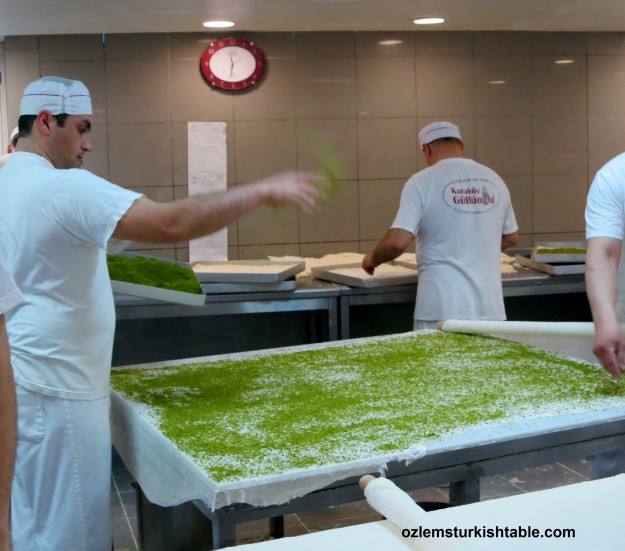
Emerald colored finest Gaziantep pistachios spread generously on the baklava sheet.

The baklava master layers 20 sheets of pastry ( and sprinkles melted butter on every 4 sheets) then generously spreads finely crushed Gaziantep pistachios – finest and only type used at baklava here-  (or at some cases walnuts) on the 20th layer.

The Usta, master cuts the sheets first horizontally and poured melted butter over them

The Usta, master cuts the sheets first horizontally and poured melted butter over them

Once the next 20 layers of sheets added on top, the master, usta cuts the sheets first horizontally and pours melted butter over them – cutting helps the butter to penetrate every level. He then cuts vertically and splashes another dose of melted butter all around. The baklava is now ready to be baked in the oven at 165 C – 330 F.

We also had a go at baklava with clotted cream and pistachios; kaymakli, fistikli bohca baklava

We also had a go at baklava with clotted cream and pistachios; kaymakli, fistikli  gelin bohcasi

We also had a go at baklava pockets with clotted cream and pistachios; kaymakli, fistikli  gelin bohcasi, another amazing treat.

Having a go at fistikli gelin bohcasi; baklava pockets with thick clotted cream, kaymak, and pistachios

Having a go at fistikli gelin bohcasi; baklava pockets with thick clotted cream, kaymak, and pistachios

While baklava was baked in the oven, the syrup is prepared, consisting of pure cane sugar, lemon juice and water. In Turkey,  there is no honey added in to the baklava syrup.

In the traditional baklava syrup in Turkey, there are pure cane sugar, lemon juice and water – no honey in it-

In the traditional baklava syrup in Turkey, there are pure cane sugar, lemon juice and water – no honey in it-

Once cooked, the hot syrup is poured over the relatively cooler baklava, and then baklava tray goes back to the oven for another 5 minutes or so to soak up the syrup. After this, the baklava is rested at a cool area.

Syrup poured on baklava; now ready to go back to the oven again

 And here is the real thing; wonderful, melt in the mouth delicious baklava. It is so light that you feel like eating ta plateful! I hope you get a chance to try the baklava in Turkey.

Fistikli ve cevizli baklava; baklava with pistachios and walnuts - what a treat

Fistikli ve cevizli baklava; baklava with pistachios and walnuts – what a treat

History of Baklava – Baklava Parade during the Ottomans

There are many theories as to the origin of baklava; but there is one thing for sure, that baklava was perfected at the Topkapi Palace Kitchens during the Ottoman Period and it was the Sultans’ favorite dessert. The importance of baklava at the Palace was not only because it was accepted as the token of wealth and sophistication ( as in the mansion houses) but also because it was a State tradition. The baklava parade that started at the end of the 17th century or at the beginning of the 18th century is example of this tradition.
When soldiers were getting their trimonthly pay from the Sultan, they were offered a big feast and on the 15th day of Ramadan they were treated to baklava. On the 15th day of Ramadan when the Sultan visited Hırka-i Serif (the cloak of Prophet Mohammed kept in Topkapı Palace) as a Caliph , baklava from the palace was sent to the Sultan’s Janissary soldiers. It was one tray of baklava for ten soldiers. The delivery of baklava to the soldiers and carrying the baklava to the barracks had then became an imposing parade.

Round tray baklava, cut in triangular slices

Round tray baklava, cut in triangular slices

Testing the Baklava

Here are some of the tests the masters, ustas at Gulluoglu carries out for a perfect baklava:

Hearing Test 
When you place a fork into a baklava you should hear a rustling sound. This means that the thin layers of dough are really thin and baklava is well cooked. The thinner the layers of dough the better the baklava.
Smelling test
When you lift to your mouth, you must smell the butter and the nut or peanut used as a filling. A good baklava should have fine ingredients.
Tasting test 
You can feel the good baklava in your mouth. Good baklava leaves a heavenly taste in your mouth and does not hurt the stomach.

My home made baklava with walnuts; delicious and easier than you think

My home made baklava with walnuts; delicious and easier than you think

I hope all these inspire you; would you like to have a go at making baklava at home? I make it with filo pastry sheets; it is easier than you think and very satisfying. My version is a little less sweeter and fragrant with a touch of lemon taste, here is the recipe  if you would like to have a go. The real thing shouldn’t be very sweet and heavy; on the contrary it should be light enough to tempt you to eat a small plateful. I think this version achieves that.

Enjoying boreks and baklavas in Gulluoglu Karakoy, Istanbul

Enjoying boreks and baklavas in Gulluoglu Karakoy, Istanbul

I will be demonstrating how to make baklava at my next Turkish Cookery class, at Central Market Cooking School, Austin – Texas on 2nd August.

The Blue Mosque, Sultanahmet Camii, Istanbul

9th July marks the start of the holy month of Ramadan this year; best wishes to all observing Ramadan; Ramazaniniz Mubarek Olsun. Baklava is one of the traditional desserts enjoyed during Ramadan, I hope you enjoy this special treat and have a chance to make it at home.

Continue Reading

Spaghetti with Fresh Peas, Sun-dried Tomatoes and Garlicky Prawns

Fresh peas are packed with flavor

Fresh peas are packed with flavor

We are a big fan of peas in our family and I especially love fresh peas. They are packed with flavor and their brightness and sweetness are so inviting. Peas work particularly well in “Zeytinyaglis”,”Vegetables Cooked in Olive Oil” in Turkish Cuisine, like in this Baby Artichokes Poached in Olive Oil with Peas, Carrots and Almonds. Dressed with olive oil and lemon juice, they are not only very healthy but also very refreshing, a joy to eat during summer time and can be kept in fridge 2-3 days.

Artichokes in olive oil, Em tennis, almond bulgur, lokum first p 015

Artichokes poached in olive oil with peas, carrots and almonds; peas work delicious here too.

I was delighted to see some delicious recipes showcasing fresh peas by one of my favorite chefs & food writer Stevie Parle and our menu was set; Spaghetti with fresh peas, sun dried tomatoes and shrimp. Good tips from Stevie when buying fresh peas; look for pods that are silky-soft, shiny and green; the peas within will not have split yet and should be small, soft and sweet. When they are really good, you can put a bowl of them on the table and you’ll find folks munching away on them with a glass of wine or beer.

Spaghetti with fresh peas, sun dried tomatoes and shrimp

Spaghetti with fresh peas, sun dried tomatoes and shrimp

I added sun dried tomatoes that needed finishing to this recipe; their tangy and sweet flavor worked well with the peas and the garlicky shrimps. I also loved the refreshing lemon zest here and the fact that a freshly cooked delicious meal ready in less than 30 minutes.

Adapted by Stevie Parle’s brown shrimp and pea taglierini 

Serves 3- 4                                            Preparation & Cooking time: 25- 30 minutes

200gr/7 oz. peas

30ml / 2 tbsp. sun dried tomatoes, cut in stripes

1-2 garlic cloves, finely sliced

180gr/ 6 ¼ oz. raw prawns, peeled

Zest of 1 lemon and juice of ½ lemon

250gr/ 8 ½ spaghetti

Salt and freshly ground black pepper to taste

Extra virgin olive oil to serve – optional


Shell the peas and rinse well. Bring a pan of salted water to boil.

Stir in the olive oil in a small saucepan and gently fry the garlic until it just begins to color. Add the prawns and season with salt and a little pepper. Stir and cook for about 2 – 3 minutes, then take the heat off and stir in the sun dried tomatoes, lemon zest and juice.

Add the spaghetti to the boiling water and cook for about 5 minutes. Stir in the fresh peas to the boiling water and cook together for a further of 3-4 minutes, until the spaghetti is just cooked. Drain, reserving a little of the pasta water. Pour the shrimp mixture into the pasta and add a dash of cooking water. Mix everything well, check the seasoning then transfer to plates. You can drizzle a little extra virgin olive oil over and serve.

Fresh peas in spaghetti with sun dried tomatoes and garlicky shrimp; a delicious and easy meal

Fresh peas in spaghetti with sun dried tomatoes and garlicky prawns; a delicious and easy meal

Afiyet Olsun,

Ozlem


Continue Reading

Turkish Coffee,Turk Kahvesi – More Than a Drink

Enjoying a delicious sip of Turkish Coffee at the Archeological Museum, Istanbul

Enjoying a delicious sip of Turkish Coffee at the Archeological Museum, Istanbul

Have you ever tried the deliciously frothy Turkish coffee? It is one of the most popular traditional drinks at home in Turkey and I love the whole ritual, the experience of it. In Turkish, we have a saying “Bir fincan kahvenin kirk yil hatiri vardir” which means “The memory of a good cup of Turkish coffee lasts 40 years. Turkish coffee is a drink of friendship; you are offered this traditional, aromatic drink wherever you go in Turkey; when visiting friends and family, in the shops, while waiting in the bank, in hairdressers.. We take time to pause and enjoy this special drink with a friend or family or sometimes simply reflect with every precious sip. A glass of water and Turkish Delights by the side complete the Turkish coffee ritual.

Deliciously frothy Turkish Coffee; Turk Kahvesi

Deliciously frothy Turkish Coffee; Turk Kahvesi

Turkish coffee is made from 100 % Arabica beans that have to be toasted to the point and ground to a very fine powder. When properly made, a delicious foam forms at the top, which is essential to any Turkish coffee. My mother loves her daily Turkish coffee but needs to limit with one a day. If she is ordering in a Café, she charmingly asks the waiter for a “guzel kopuklu kahve lutfen” which means  “Turkish coffee with a nice foam at the top please”; that is her treat for the day and she thoroughly enjoys that one cup with a smile on her face.

Turkish coffee ritual; a glass of water and Turkish delights accompanies Turk Kahvesi

Turkish coffee ritual; a glass of water and Turkish delights accompany Turk Kahvesi

Although Turkish coffee was first cultivated at the southern edge of the Arab peninsula, it was via the Ottoman Empire that the fame of coffee spread to Europe. Within just a few years of its introduction to Europe, hundreds of coffee houses sprung up in Istanbul alone, and coffee drinking became such an important part of daily and ceremonial life that the Sultan’s coffee set was carried during royal processions; every wealthy household had a servant whose sole task was to prepare coffee and under the laws the failure of a husband to provide his wife with coffee was grounds for divorce (so they say)!

Reading the Turkish coffee cup; a childhood past time

Reading the Turkish coffee cup; an innocent childhood  fun

When I was a little child, my mother used to make us very milky Turkish coffee – so we could join in the ritual with them :). And just for the fun of it, once in a while we used to turn our coffee cup upside down to its saucer after finishing, in search of our fortune. My mother would always see the happiest things inside the cup; if there is “a bird” in the cup, that is good news, if there are “narrow lines”, there is a travel on the horizon; if there are “horses” in the cup, that is good fortune. Nothing ever bad appeared in our cups and we loved listening to mum and this innocent fun with giggles.

When we stopped for a break while visiting Ephesus last April, I reminisced this childhood memory and I ordered my Turkish coffee. After drinking, I turned my coffee cup upside down to its saucer, eager to see what waits for me. And to my surprise, I did spot a horse in the cup (can you see it?), with a smile on my face. I am now looking forward to this fortune!:)

Though not the traditional way, a little hot milk may also be added to Turkish coffee in some parts of Turkey; like Turkey’s For Life experienced in Van; you may enjoy this version if you like it less strong. Please also check out A Seasonal Cook in Turkey for delicious Turkish coffee experiences in Istanbul.

A very aromatic Menengic Coffee

A very aromatic Menengic Coffee

How about Menengic Coffee? This aromatic Southern Turkish Specialty features Menengic, known commonly as terebinth and turpentine tree, is a species of Pistacia, and wildly grown in Southern Turkey, part of the national flora. Cooked with milk, you can certainly get the wonderful pistachio taste, a unique experience.

How to Make Turkish Coffee

Here is how to make proper Turkish coffee; I hope you can get to try this special drink sometime, if not already;  Turkish coffee really is more than a drink for us.

Cezve; long handled pot is an essential equipment to make Turkish coffee.

Cezve; long handled pot is an essential equipment to make Turkish coffee.

To make Turkish coffee, you need the right equipment: a special long handled pot called “cezve” and small coffee cups called “fincan”. The size of the pot is significant. It must hold almost double the amount of the water used to have adequate “room” on the top for the foam to rise.

Turkish coffee set; all ingredients that you need!

Turkish coffee set; all ingredients that you need!

There are different sizes of “cezve”, the long handled pot, depending on the number of persons for whom you wish to make Turkish coffee. A well-made coffee must have froth on the top and you cannot have a good result if you prepare the coffee for 2 persons on a pot for 4.

Stir in s heaped teaspoon of Turkish coffee to the pot.

Stir in a heaped teaspoon of Turkish coffee to the pot.

Into your “cezve”, put one coffee cup of water for each person, 1 heaped teaspoon of coffee and 1 rounded teaspoon or less of sugar. Traditionally, the amount of sugar should be known beforehand, i.e. “az sekerli” (with little sugar), “orta sekerli” (medium), or “sekersiz” (with no sugar). Skip the sugar if preferred. Stir well, put over low heat and bring slowly to boil.

As the froth forms on top, remove and divide the froth into the cups.

As the froth forms on top, remove and divide the froth into the cups.

As it gently start to boil, the froth forms on top and rise. Just before it overflows, remove and divide the froth into the cups. Then bring to boil again and divide the rest out to the cups. Your Turkish coffee is ready.

Deliciously frothy Turkish Coffee; Turk Kahvesi, afiyet olsun!

Deliciously frothy Turkish Coffee; Turk Kahvesi, afiyet olsun!

Turkish Delight, lokum traditionally accompanies the Turkish coffee and it is a perfect fit. You can also make your own Turkish Delight if you like, here is my Turkish Delight recipe.

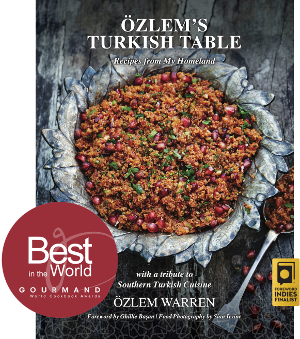
Turkish coffee, Turkish delight and over 90 authentic Turkish recipes with stunning photography also included at my Gourmand winner cookery book, Ozlem’s Turkish Table – you can order Signed copies at this link, also check out the ebook options, – hard back copies delivered worldwide.

Afiyet Olsun; I hope you enjoy your Turkish coffee,

Ozlem


Continue Reading