Cookery Classes

I teach Turkish cooking classes in England,Turkey & USA, hope you can join us!,
Find Out More

Recipes    

Turkish cuisine provides healthy, hearty, delicious food for family and friends.
Find out more

Savory Pastries

Boreks, Simit, Turkish Breakfast and More – Some of My Favorite Turkish Treats & How to Re-create Them

Living abroad, there are certain Turkish food, especially the Turkish street food, places (and of course, people) that I dearly miss – and I am sure it is the same for many of you, who live outside of your homeland.

The Bosphorus, cruising through Sea of Marmara in ferries, Topkapi Palace, Hagia Sophia - some of my favorite things in Istanbul

Once settled down at your “new home”, the feeling of  missing replaces itself with “how to recreate these treats in your new home phase”. This is how I started blogging about my homeland, Turkey, and Turkish food, and I am grateful to have a chance to connect and share the many wonderful things my homeland offers with you. I am delighted to see that we can recreate many of our favorite food, with a little substitution or tweak here and there.
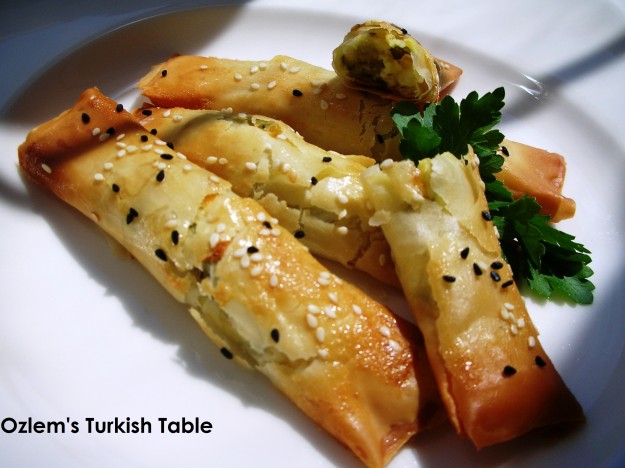
Patatesli & peynirli borek; filo pastry rolls with cheese and potato

Take the boreks; one of my favorite parts of Turkish cuisine, the stuffed, filled pastries. Traditionally, we would use the fresh, paper thin sheets of pastry, yufka, widely available at home. Living in England, I cannot get yufka, but the filo pastry sheets you can get at the supermarkets work as a good substitution to make boreks. One thing to bear in mind that they can get dry easily, and that you need to keep them moist with a damp cloth over them, while working. Here is a good demo on handling filo pastry.
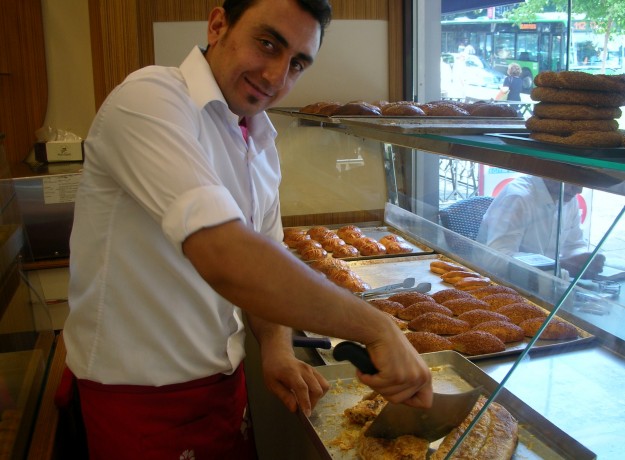
Borekci, borek shops in Turkey sell all kinds of freshly made savory pastries with different fillings, one of my favorite stops!

We use different kinds of fillings for our boreks; some with leek and cheese, some with potato, cheese and parsley, onion and ground meat and many more. You can bake these pastries using filo pastry sheets ahead of time, and leftovers can be frozen successfully. My children love these boreks;  if frozen, grease a baking tray and place them on the tray. Then reheat in the oven at 180C/350 F for about 15-20 minutes. They magically appear on the table and are gone very quickly!
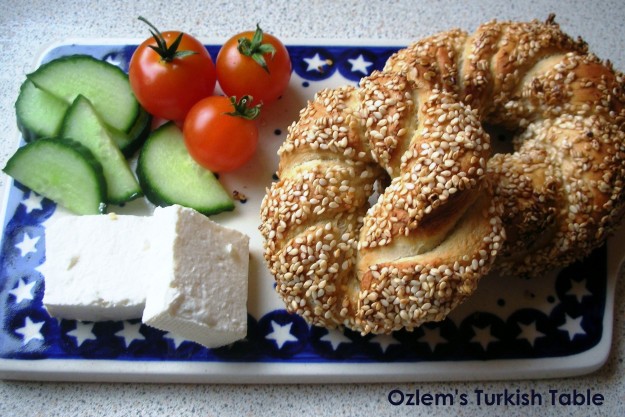
Simit, the sesame seeded bread rings are the ultimate Turkish street food.

Simit, the sesame seeded bread rings are another favorite. With a cup of cay -Turkish tea-, sliced cucumbers, tomatoes and cheese by the side, they are the ultimate Turkish breakfast for me . And yes, you can bake your own sesame encrusted, golden rings, simit, easier than you think : )
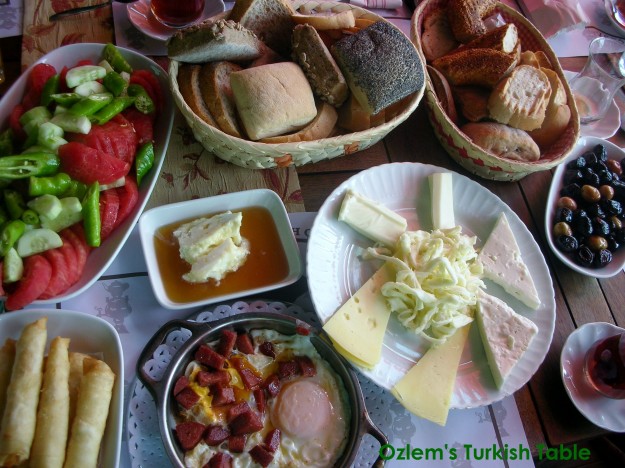
The wonderful Turkish breakfast with simit, cay, sliced cucumbers and tomatoes, olives, cheese, eggs with Turkish sausage, sucuk, honey and more..my favorite meal of the day!
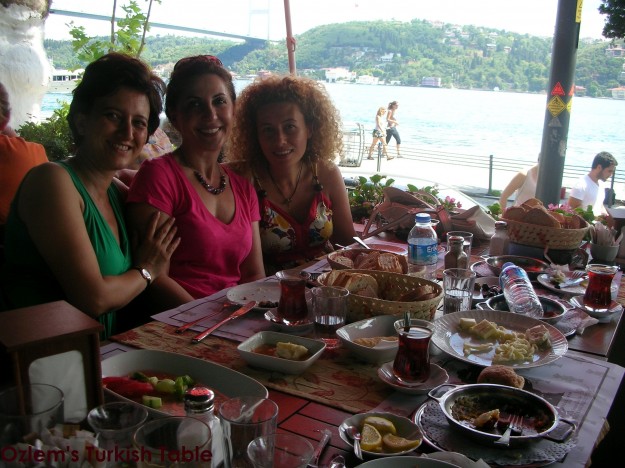
And, a leisurely Turkish breakfast shared with friends and family by the Bosphorus is simply unbeatable, for me.

Balik & ekmek, Turkish grilled (or lighly fried) fish sandwich is another delicious street food at home. Fisherman prepare the catch of the day in their boats; a simple grill with salad, slices of onion on a fresh loaf of bread; just wonderful.
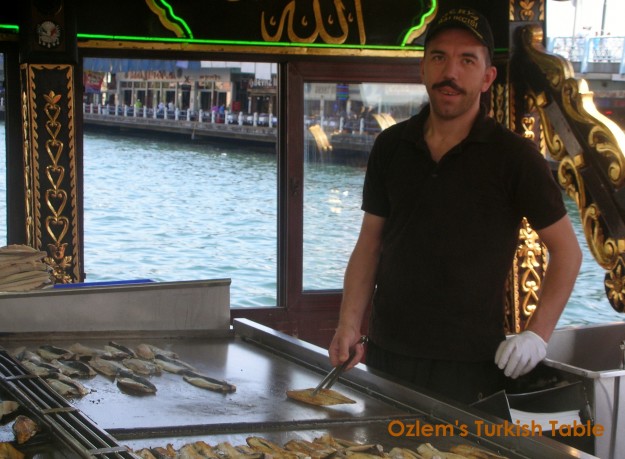
Fisherman preparing "balik&ekmek" in a traditional boat in Golden Horn, Istanbul

I re-created my version of balik ekmek with a delicious, refreshing piyaz salad with sumac, onion rings, parsley and tomatoes by the side – all I need to do is to I close my eyes and visualize myself to be by the Bosphorus in Istanbul!
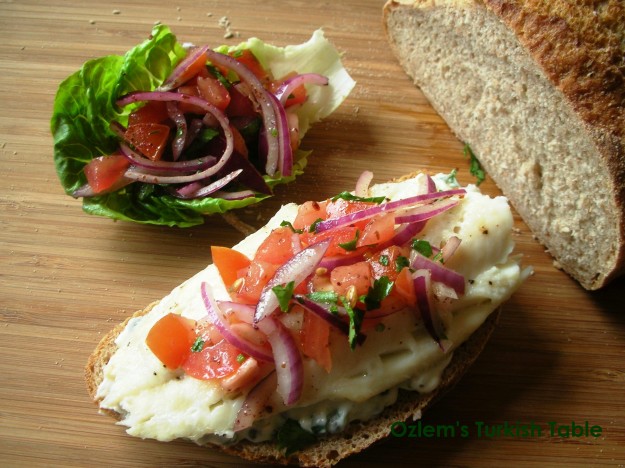
Grilled fish sandwich goes so well with the refreshing piyaz salad of onion rings, tomato and parsley with sumac dressing.
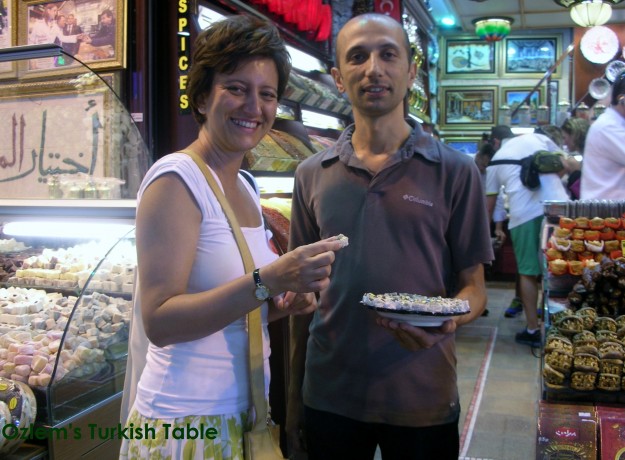
Turkish delight, lokum with rose water, pistachios, walnuts, or plain – sade -; all delicious treats.

Fragrant, melt in the mouth Turkish delight is another treat I dearly miss – my children prefer Turkish delight over chocolate! – Then, you find a way to re-create it, and delighted to see that this Turkish delight recipe works really well! It is a wonderful treat to make for your friends and family for special occasions.
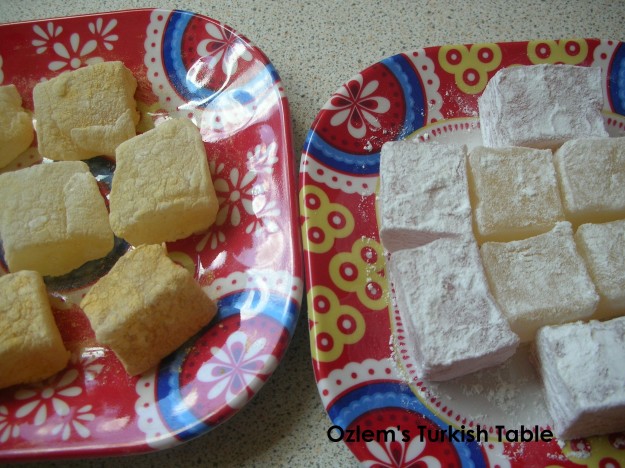
Fragrant, home made Turkish Delight, easier than you think.

I hope you can have a go and start re-creating any of your favorite food from your homeland; it is easier than you think, and can be really rewarding too.
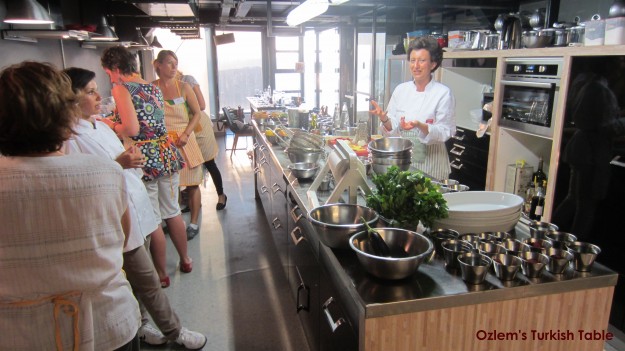
Cooking together with participants at the Istanbul Culinary Institute

One way of getting in to re-creating your favorite dishes maybe attending a cookery workshop and see at firsthand how to break down the recipes and follow them. Many of participants attended my cooking classes expressed how pleasantly surprised that they can make the dishes easily and the experience was inspirational. My next Turkish cooking class in Istanbul Culinary Institute will be on Feb 19th 2013.

I am also grateful to be able to connect some wonderful bloggers who blogs about Turkey, Turkish cuisine and its people, with wonderful, inspirational photos and insights. Here are some of them that regularly follow and get a wonderful dose of home:

A Seasonal Cook in Turkey: Claudia’s delicious blog follows the seasonal produce in Turkey with wonderful market photos. Claudia also does great Old City Walks with Istanbul Eats, be sure to check out.
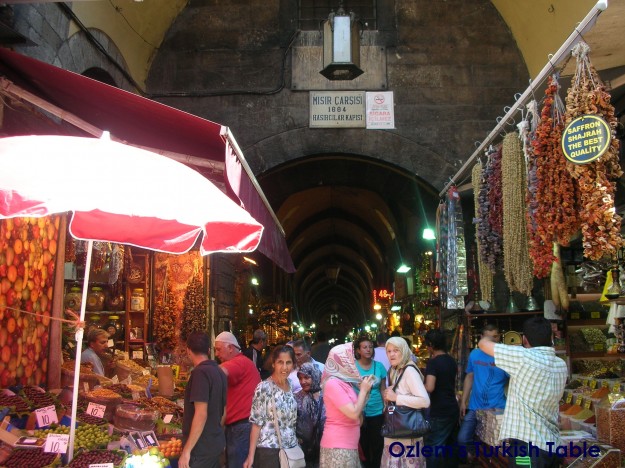
Entrance of Misir Carsisi, Spice Market - Istanbul; a foodie heaven.

Turkey’s for Life, Turkish Travel Blog  and Archers of Okcular  feed us with fabulous photos, stories, news around Turkey, they are a joy to follow! My Turkish Joys is another lovely blog, with wonderful recipes and travel photos from home. Joy is also a brilliant pastry chef and know all things about pastry, so be sure to check her blog out.
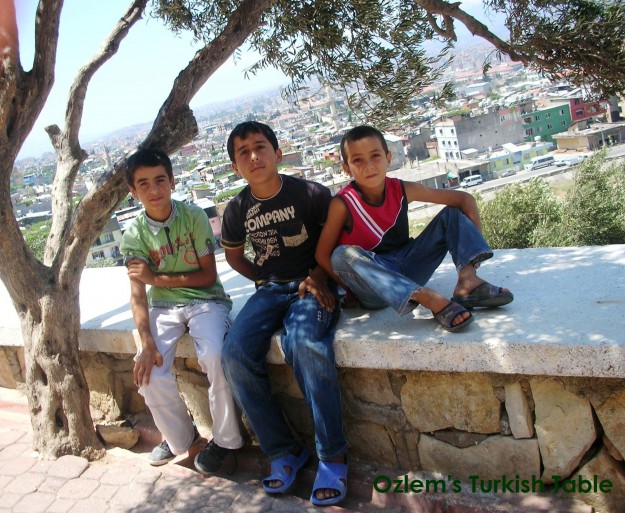
Let the children guide you in Antakya; they are always happy to help.

Like many things, it is the human factor, friendly people; a warm smile, hospitality that makes a place special that makes us to go back there again and again. I think that sums up my homeland for me.
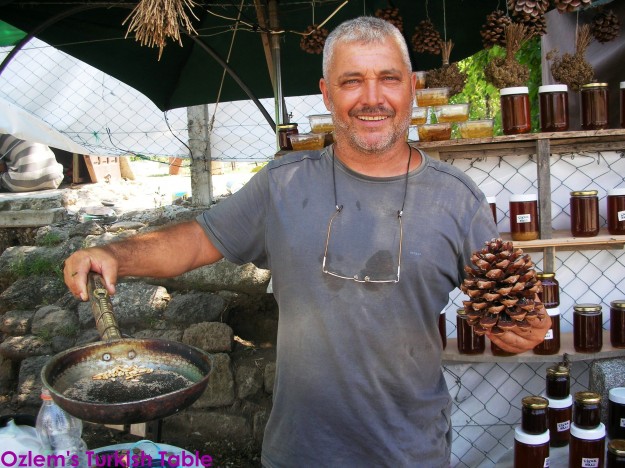
A local in Pergamum, selling region's delicious honey and pine nuts - and letting us have a little sample:)

Last but not least, I am also very grateful for your company to share a dose of home with me, following my blog, your comments and feedback; they are very precious, thank you very much. I hope these photos and information inspires you to explore Turkey, have a go at the recipes to treat yourself and family, friends.
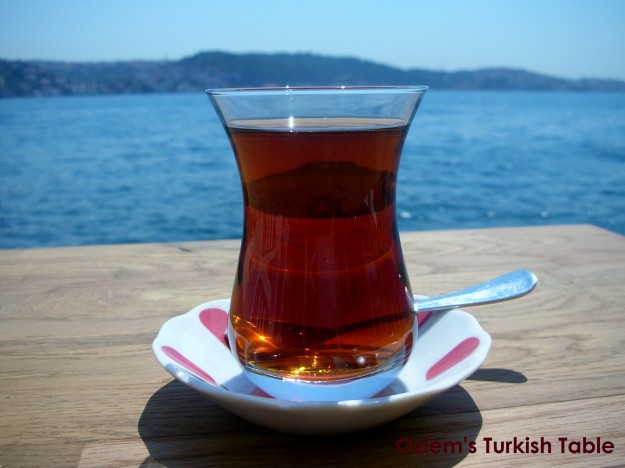
A glass of cay by the Bosphorus = happiness 🙂

Afiyet olsun & happy travels to you all,

Ozlem
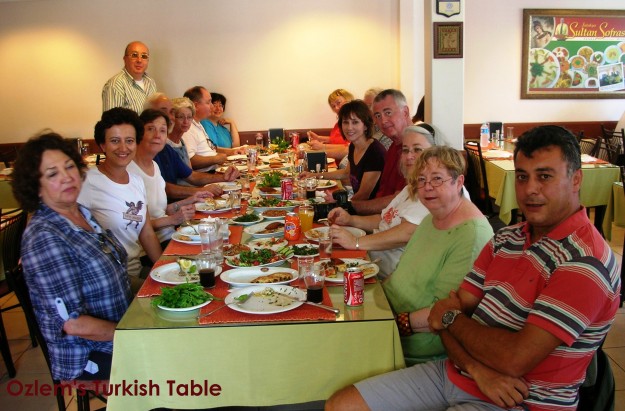
Sharing a delicious feast in Antakya during my culinary tour in 2009.

If you would like to join us and explore Turkey from a local’s perspective in my next culinary and cultural tour in April 2013 please contact me.


Continue Reading

A Favorite British Teatime; Plain and Savory Scones – Peynirli Pogaca

Plain and savory scones with feta cheese and parsley, just baked

I love the British teatime tradition and all the treats that come with it. Scones are a special favorite; I simply can not resist them with clotted cream and jam over the top. So I was delighted to see their appearance on the Telegraph food writer Rose Prince’s Baking Club  a few weeks ago.

What I also loved seeing at the column was that Rose Prince provided recipes for plain as well as the savory scones, which is quite unusual. Savory pastries, pogaca as we call it in Turkish, (with various fillings e.g. with cheese, grated potatoes, courgettes, onions) are very common in Turkey, and one of the favorite accompaniments to our afternoon tea. I vividly remember my mother baking pogacas with various fillings for afternoon teatime gatherings in our home. The savory scone recipe here therefore has a Turkish influence to it, as I added crumbled feta cheese and flat parsley to mine (you can replace the feta cheese with fresh goats cheese for a less salty and milder flavor, as Rose Prince did).

Cheese and parsley scones (peynirli pogaca), lovely with a cup of tea

Though there are only a few ingredients that make the perfect scone, it can be of a challenge to get that tearable soft inside, that wouldn’t go dry.Rose Prince gave two recipes using plain flour in one and strong stoneground strong white flour in another, which makes the scones lighter with a slightly elastic crumb. I had a go with the plain flour, as that was the one available, and we all very much enjoyed the end result.

Makes about 12 scones

Preparation time: 20 minutes               Baking time: 15 minutes

390gr plain flour

200gr butter

1 tsp (5gr) – or a little less, if you prefer – salt

2 tbsp baking powder

300ml butter milk

If you’d like to make half of the scones savory, please include:

80gr feta (or fresh goats cheese or cottage cheese for milder flavor), crumbled

Handful of flat leaf parsley (or fresh dill), finely chopped

Clotted cream and jam to accompany the plain scones

Preheat the oven to 220 C/425 F/Gas 7

Put the flour in a bowl and rub the butter into it until it has a crumbly appearance. Add the baking powder and the salt and mix lightly but well with your hands. Add the buttermilk, mix with a spoon, until it just about holds together and tip out onto a floured work surface. Fold the dough onto itself two or three times. (Work the dough as lightly as possible, and keep it cool. Too much kneading will make the dough tighten up and the scones will not be airy.) Bring the dough into a ball shape and dust with flour.


Work feta (or any other cheese of your choice) and parsley into the dough

Divide the dough in two halves, if you are making savory as well as plain scones like I did.  For savory scones, dust first half of the dough with a little more flour and work the cheese and parsley into the dough until it ripples through. On a floured surface, roll lightly with a rolling pin to a thickness of 3cm. Use a straight edged round cutter, 4cm in diameter, to cut out the savory scones.

Shake them out of the cutter and place on a baking sheet lined with baking parchment.

For plain scones, roll the other half of the dough and repeat the same procedure as above.

Bake the scones for about 15 minutes , or until pale gold and nearly doubled in size.

Teatime favourite; plain scones with clotted cream and jam

Afiyet Olsun!

Tuesday, March 20th; Offical Start of Spring

My diary showed Tuesday, 20th March, as the offical start day of spring. All the wonderful blossoms, newly emerging buds, daffodils are all around to prove it, so wonderful and uplifting to look at.

Beautiful daffodils are everywhere at the moment

Spring; beginning of new life, new growth, new hopes, beginnings. I hope you enjoy the spring shots from the RHS Wisley Gardens, England.

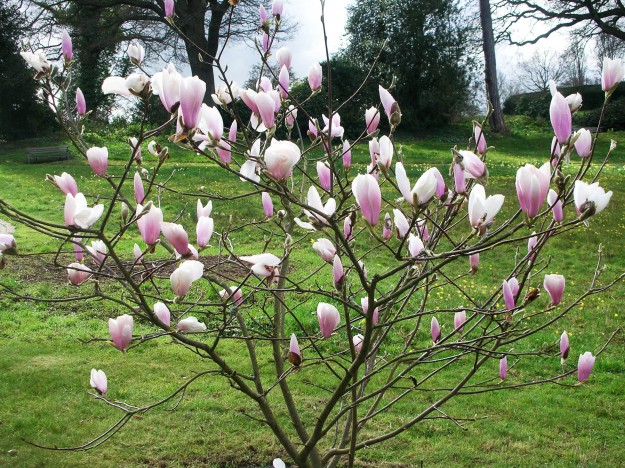
Magnolia tree with lovely pink blossoms

Continue Reading

Simit; Sesame-Encrusted Turkish Bread Rings

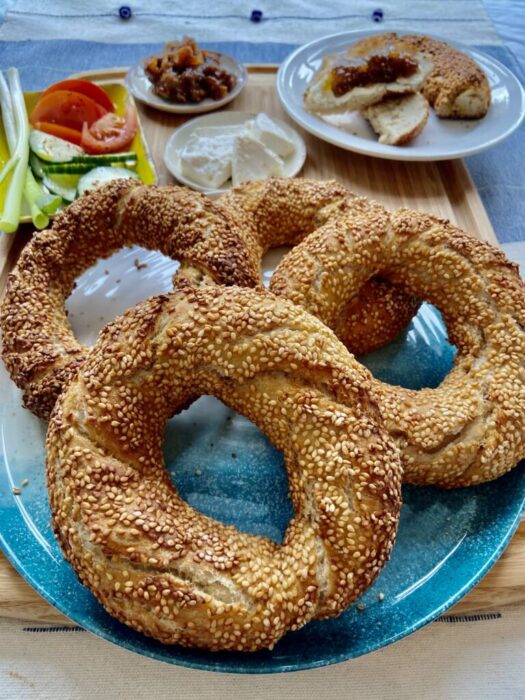
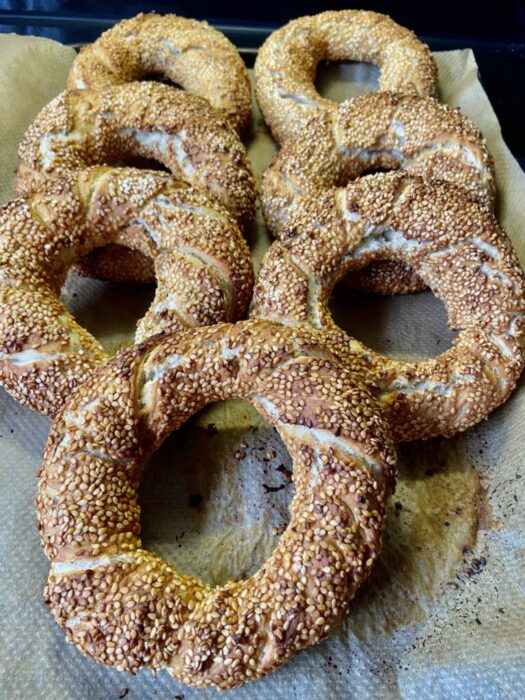
Simit is indeed the quintessential Turkish food; these sesame-encrusted bread rings must be the most popular snack at home. You can have simit for breakfast with a cup of cay (tea), sliced cucumber, tomatoes, feta cheese and olives. You can enjoy them for a mid morning or afternoon snack with cheese or simply plain. Turks prefer savory accompaniments to simit, though I must say it is also lovely over some butter and jam. Their flavor and deeply satisfying texture are quite unlike anything else.

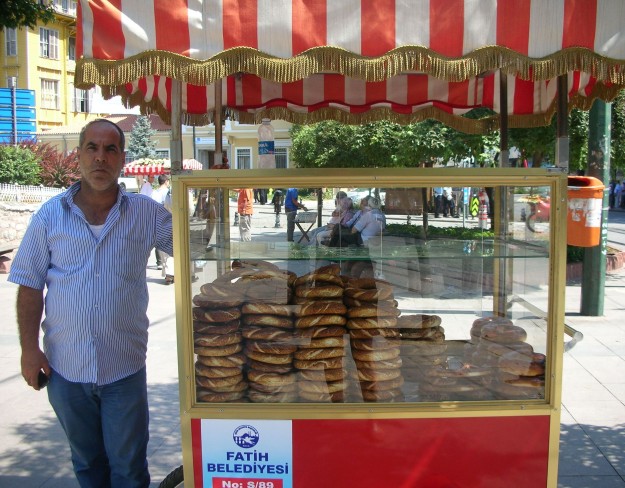
Traditional simit stall (simitci) in Istanbul

There are mobile simit stalls everywhere, especially in Istanbul (Istanbullus pride themselves as to have the genuine article). Recently, there are also Simit Houses opened all around the country, where you can enjoy simit with various fillings; cheese, olive paste, sucuk (Turkish spicy sausages made from dried cured beef). A magnificent revival of this all time favorite street food.

 When I saw the Simit recipe at Leanne Kitchen’s delightful book  Turkey; Recipes and tales from the road, I was over the moon. No one bothers making simit at home, as it is so widely available and so good. But living abroad, you don’t mind tackling to make it and would be surprised to see how easy to make them. This simit recipe is adapted from Leanne Kitchen’s version and based on Australian cup measurement (1 US cup in volume equals about 0.95 Australian cup measurement) . I hope you enjoy them at least as much as we did.

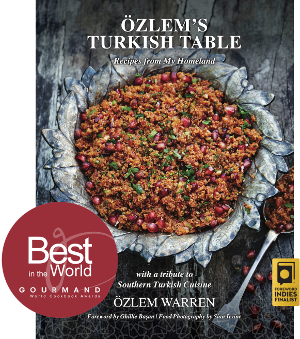
We love savoury pastries in Turkish cuisine;  variety of boreks, gozleme, pogaca, flatbreads with various fillings, pide and regional specialty pastries are all included at my cookery book (though please kindly note that simit is not at my current book), Ozlem’s Turkish Table, Recipes from My Homeland. Signed copies are available at this link, and it is delivered worldwide including USA, we hope it would bring joy for home cooking.

Makes 8

Prep time: 40 minutes (+1 hr for the dough to rise) Baking time:15-18 minutes

1 pinch sugar

15ml/3 teaspoons dried yeast

500gr (1lb 2oz/3 1/4 cups (Australian) or generous 4 US cups) plain flour

1 1/2 teaspoons sea salt

125ml (4 fl oz/1/2 cup) pekmez (molasses like syrup, see note)

155g/5 1/2oz golden sesame seeds


Combine the sugar and 60 ml (2fl oz/ 1/4 cup) lukewarm water in a small bowl, then sprinkle over the yeast. Set aside for about 8 minutes, or until foamy, then add another 310 ml (10 3/4 fl oz/ 1 1/4 cups) lukewarm water.

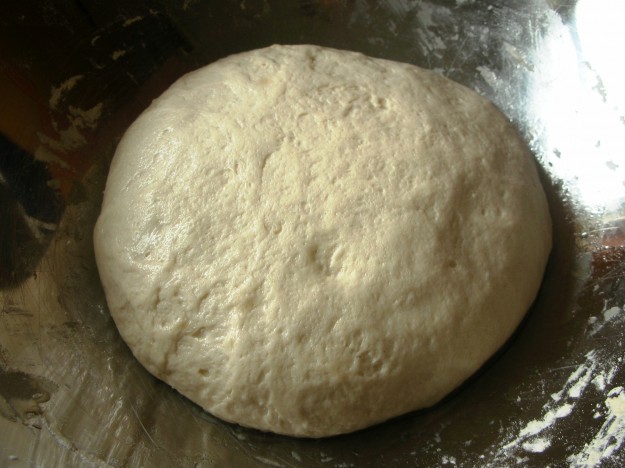
 Combine the flour and salt in a bowl, then add the yeast mixture and stir to form a coarse dough. Turn out onto a lightly floured surface ( a little bit of extra flour on the surface will help the dough to come together) and knead for 6-7 minutes, or until the dough is smooth and elastic. Roll the dough into a ball and place in a lightly oiled bowl, turning to coat. Cover with plastic wrap and set aside in a warm, draught-free place for 45 minutes to 1 hour, or until doubled in size.

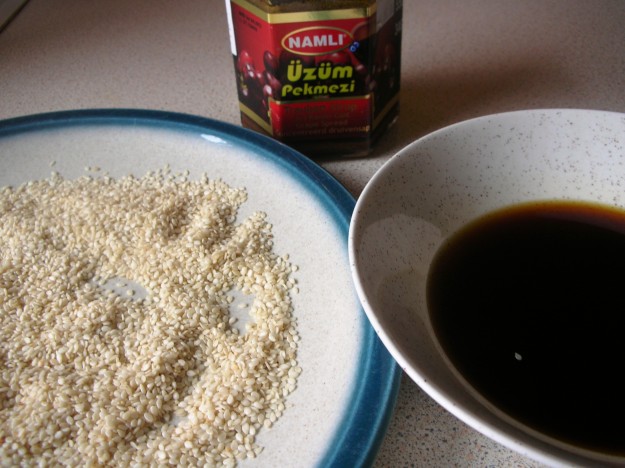
Preheat the oven to 220 C (425 F/Gas 7) and line a large size baking tray with baking paper. Knock back the dough on a lightly floured work surface and divide it into 8 even sized pieces. Combine the pekmez with 60 ml/2fl oz water in a large bowl. Place the sesame seeds on a large plate. Working with one piece of dough at a time, use your hands to roll the dough out to make 60 cm (24″) long ropes. Fold in half so two ends align, then lift off the board and use your hands to twist each rectangle into a two stranded “rope”. Place back on the work surface and join the ends together to make a circle, pressing the ends firmly together to seal. Repeat with the remaining dough to make 8 rope circles.

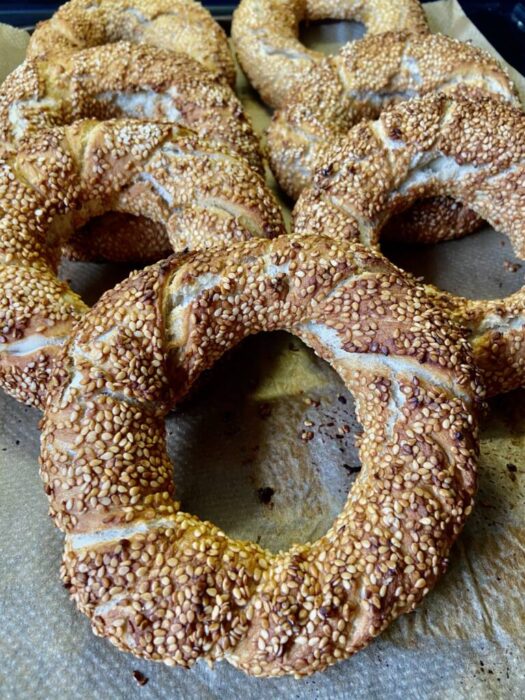
Dip each ring, first into the pekmez mixture, immersing completely to coat, then drain well and toss in the sesame seeds, turning gently to coat. Transfer to the prepared tray and set aside at room temperature for about 20 minutes, to puff slightly. Bake in the oven for 15-18 minutes, or until deep golden and cooked through. Transfer to a wire rack to cool. Simit are best eaten on the day of making but will keep, frozen in an airtight container, for up to 1 month.

 Note: Pekmez is a molasses-like syrup made from the juice and must of certain fruits, usually grapes or figs. It is available from Middle Eastern and Turkish grocery stores.

 Afiyet Olsun,

Ozlem

Continue Reading